
Contents
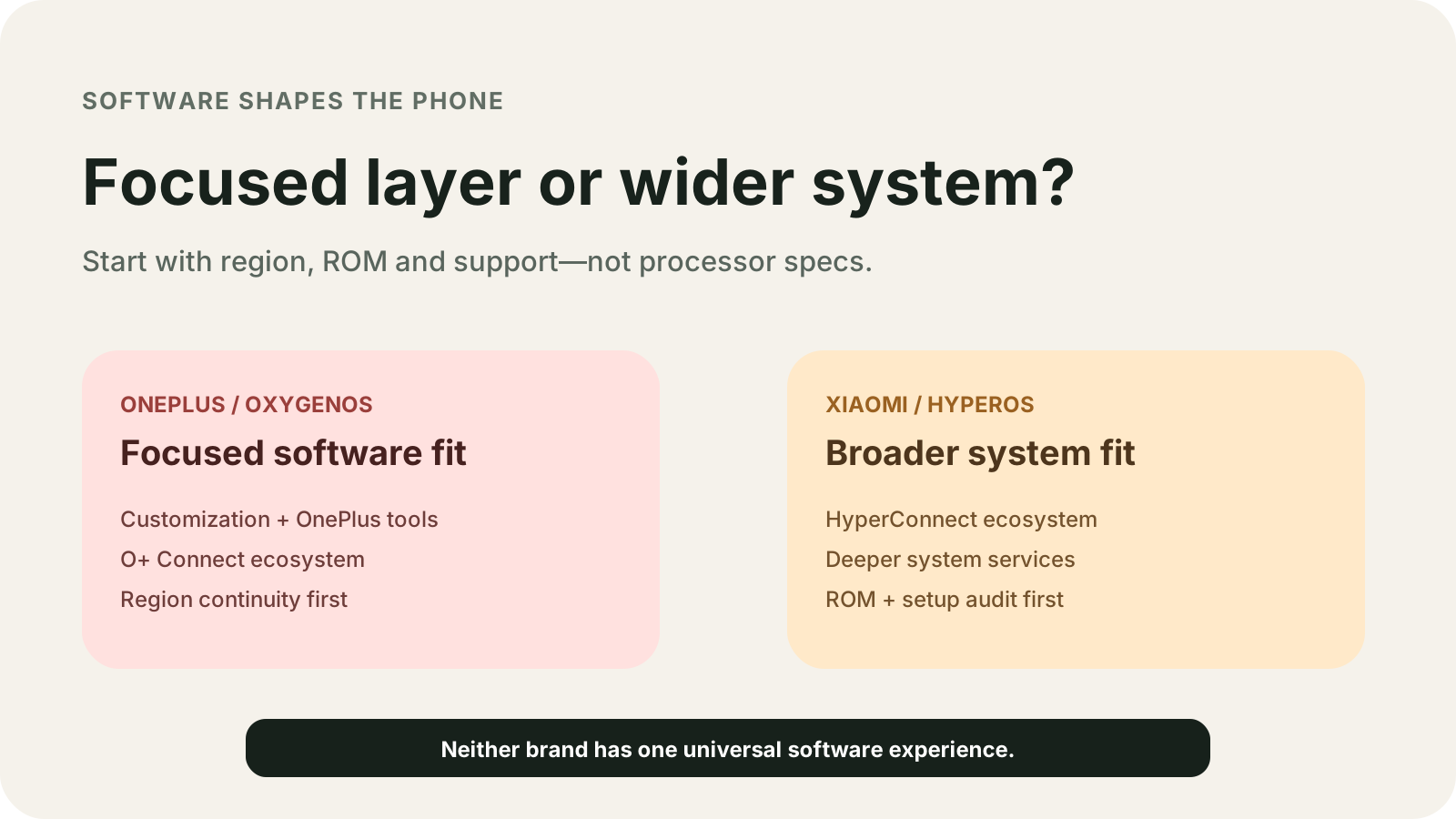
Picking the wrong software experience fails the phone you meant to keep when an eligible Europe or North America OnePlus moves from OxygenOS to ColorOS, or when the stored security end month is already past. Choose OnePlus when the UK smartphone end date still covers your plan and the notice fits that device, and choose Xiaomi, REDMI, or POCO when the HyperOS 3 global page names the model.
More of this column sits in the Android buying guides.
OnePlus fits when the UK smartphone end date still covers the years you will keep the phone and the Europe or North America notice matches that device. A Xiaomi, REDMI, or POCO phone fits when the HyperOS 3 global page names the model and the phone is a global version outside the Chinese Mainland. The UK page pledges a minimum of three (3) years of security updates for smartphones and tablets after product launch, then stores a separate end date on each smartphone-tab row. Xiaomi’s security FAQ prints a typical floor of at least 2 years after first shipment and names no model end date. Hardware specifications such as price, RAM, battery capacity, refresh rate, and camera sensors vary by individual SKU.
The US and Europe notices, the UK security page, the OxygenOS 16 launch page, and the HyperOS 3 global page were saved on 18 October 2026. [1] [2] [3] [4] [6] [7]
Scroll horizontally to view all table columns.
| Input or item | Typical value or source | Why it matters |
|---|---|---|
| Europe and North America notice | Product rollouts conclude in those regions. Existing devices keep software updates, security patches, and after-sales support. ColorOS 17 is voluntary for eligible devices after official release. Eligible models and the ColorOS 17 date are blank. | The OxygenOS layer can change on an eligible phone. The notice does not say which phone is eligible. |
| UK smartphone and tablet floor | Minimum of three (3) years of security updates after product launch. Audio on the same page is a minimum of one (1) year. Wearables are a minimum of two (2) years. | The 3-year sentence is the floor. It is not the model end date. A watch does not inherit the phone floor. |
| UK smartphone-tab end date | Stored beside each named phone. OnePlus 13 is 2031/01/07. OnePlus 10 Pro is 2026/01/01. | A stored end month already before October 2026 fails a multi-year plan. |
| Xiaomi, REDMI, and POCO security FAQ | Typically at least 2 years after first shipment of that model. Some models receive 3 years or longer, subject to actual conditions. No model end date. | Years left stay blank until a shipment date and a model row exist. |
| HyperOS 3 global page | Outside the Chinese Mainland. Three soft-release windows, October 2025 through March 2026, with named models. The list can be adjusted. | A window is a version rollout. It is not a security end date. |
| OxygenOS 16 launch page | Launch event dated 16 October 2025. The three-hour reels line and the one-hour gaming line are footnoted to OnePlus 13 with OxygenOS 16. | Those lines stay on that test device. |
| Price, RAM, battery capacity (mAh), refresh rate, camera | Blank. The pages saved here do not print them for this pair. |
Scroll horizontally to read the labels in this diagram.
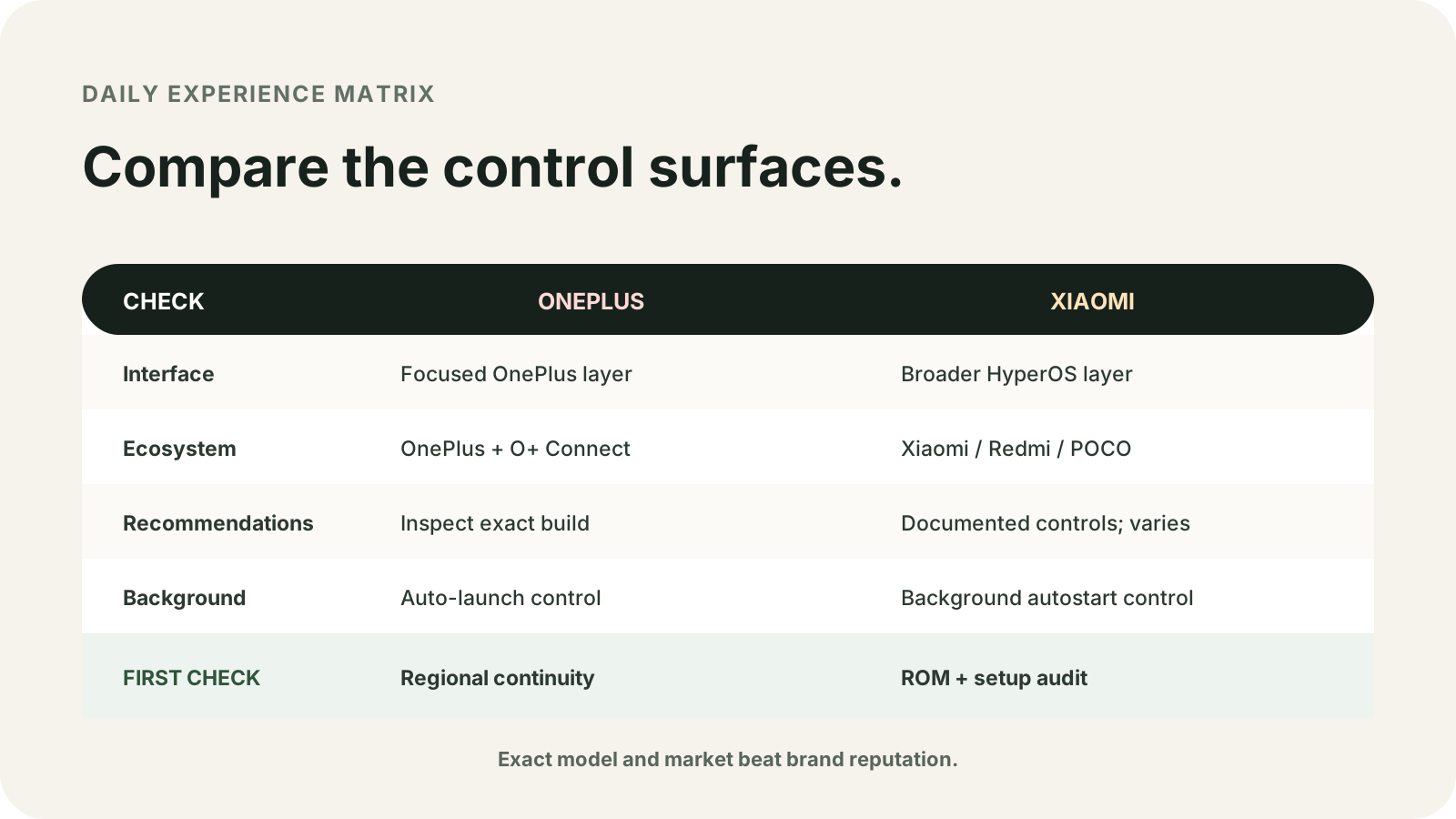
Green means the notice matches your region, the stored end month is still ahead of October 2026, and the HyperOS 3 page names a global model if that is the phone in your hand. Yellow means a blank: no eligible-model list, no Xiaomi end date, or no shipment date. Red means the stored OnePlus end month is already before October 2026, or the HyperOS 3 page you are reading is the global page and the phone is a mainland China unit.
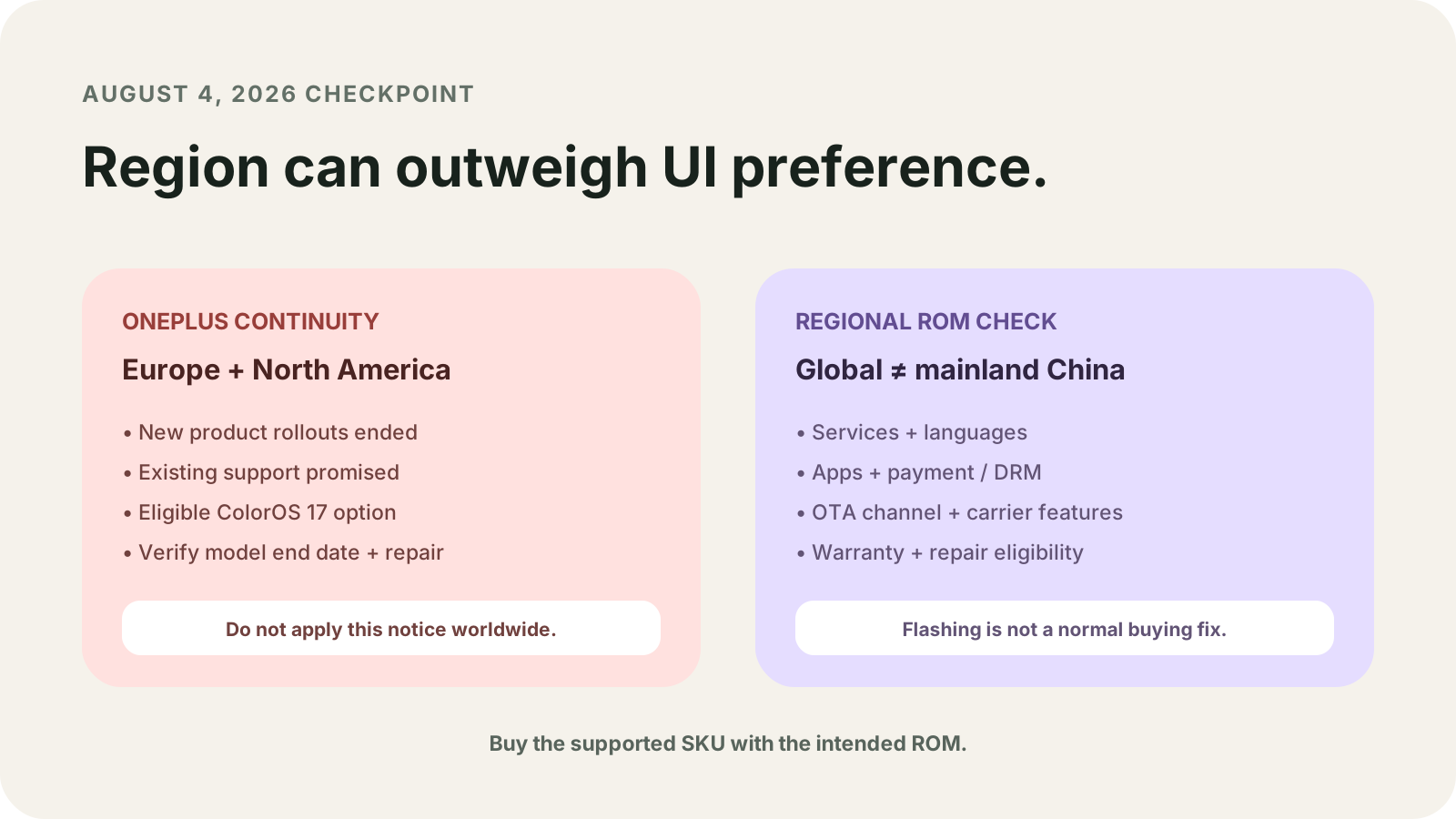
The Europe and North America notice can change OxygenOS
The US notice and the Europe notice use the same opening: OnePlus is concluding product rollouts in Europe and North America, and existing devices keep software updates, security patches, and after-sales support. Customer-service channels stay open under the standard warranty and support obligations. Consumer-protection rights are unaffected. [1] [2] Neither notice prints a publication date. This page uses the copy saved on 18 October 2026.
After the official release of ColorOS 17, an existing device inside the eligible upgrade scope can voluntarily update. A legacy model outside that scope continues to receive software maintenance. The US wording is “software maintenance.” The Europe wording is “ongoing software maintenance.” Users can choose to stay on OxygenOS. Someone who does update can roll back to OxygenOS, and the rollback versions wait on a later official announcement. The notices print no eligible-model list and no ColorOS 17 release date.
The US notice prints a close time for communityus.oneplus.com of “11:59PM ET,August 16, 2026,” and says community content is no longer publicly accessible after that closure. The Europe notice says the OnePlus Community in Europe remains open at this time, and the OnePlus Store in Europe remains open at this time. The US notice does not print a store-status line, so the US store cell stays blank.
The notices name Europe and North America. They do not print a worldwide end of product rollouts. A phone outside those regions needs its own local page. Warranty coverage follows the product warranty terms. Eligible devices keep repair and after-sales access, and the US notice points that access to service.oneplus.com.
Dominant failure mode: buying the phone for a permanent OxygenOS interface when the eligible ColorOS 17 list is blank. Prevention: treat ColorOS 17 as a voluntary path for an unlisted eligible set, and keep the current layer until that set is printed for your model.
The security end date is the model row
The UK page pledges security updates for a minimum of three (3) years for smartphones and tablets after product launch. The same paragraph sets audio at a minimum of one (1) year and wearables at a minimum of two (2) years. The smartphone tab and the IoT tab then store an end date beside each product name. Tablets sit on the IoT tab. Pad 3 is stored as 2031/06/19. A tablet does not inherit a phone’s date. [3]
The page says the list is for reference only, and that the details are subject to the updates the device actually receives. An operating-system upgrade may delay the current month’s security update, and the new OS version includes the latest security patches. Delivery times may vary by country, region, or model. A chip-supplier patch can miss the current month and arrive in a later security update. The counting method for any brand’s own row is in how Android update support is counted. A Pixel or Samsung year count does not move a OnePlus or Xiaomi row.
The dates below are the slash dates stored in the page script, in that script’s order. The page formats them in the browser’s local calendar. This article quotes the stored dates. Status 1 is the smartphone tab.
Scroll horizontally to view all table columns.
| Smartphone-tab name | Stored end date |
|---|---|
| OnePlus 15R | 2031/12/31 |
| OnePlus 15 | 2031/11/13 |
| OnePlus Nord 5 | 2031/07/08 |
| OnePlus Nord CE5 | 2031/07/08 |
| OnePlus 13 | 2031/01/07 |
| OnePlus 13R | 2031/01/07 |
| OnePlus Nord 4 | 2030/08/08 |
| OnePlus Nord CE 4 Lite | 2027/07/01 |
| OnePlus 12 | 2029/02/01 |
| OnePlus Open | 2028/10/01 |
| OnePlus 12R | 2028/02/01 |
| OnePlus 11 | 2028/02/01 |
| OnePlus Nord 3 | 2027/07/01 |
| OnePlus 10T | 2026/08/01 |
| OnePlus Nord CE 3 Lite | 2026/04/01 |
| OnePlus 10 Pro | 2026/01/01 |
| OnePlus Nord CE 2 Lite | 2025/05/01 |
| OnePlus 9 Pro | 2025/03/01 |
| OnePlus 9 | 2025/03/01 |
| OnePlus Nord 2T | 2025/03/01 |
| OnePlus Nord CE 2 | 2025/03/01 |
| OnePlus 8T | 2024/10/01 |
| OnePlus Nord 2 | 2024/07/01 |
| OnePlus Nord CE | 2024/06/01 |
| OnePlus Nord | 2023/07/01 |
| OnePlus 8 | 2023/04/01 |
| OnePlus 8 Pro | 2023/04/01 |
A name missing from this tab stays blank. The script does not store a OnePlus Nord CE 5 with a space, a OnePlus 14, or a OnePlus 16.
Xiaomi’s global FAQ covers Xiaomi, REDMI, and POCO. It says security updates generally include the latest patches, vulnerability fixes, and other security improvements. Typically, Xiaomi maintains security updates for at least 2 years after the first shipment of a certain device model. Some models receive 3 years or longer, subject to actual conditions. A very serious vulnerability can still get a fix for a device on the EOL list. The FAQ names no model, no first-shipment date, and no end date. [7] The HyperOS 3 soft-release windows below are version schedules. They do not fill this blank.
Month gap = (end year - 2026) x 12 + (end month - 10).
The check month is October 2026, the month this page was updated. This is month-start arithmetic on the stored year and month. The stored day is unused, so the true gap can shift by less than a month. A negative month gap means the stored end month is already before the check month.
Worked example. A 4-year hold is 48 months. That 48 is a planning assumption. None of these pages print 4 years as a spec for this pair.
OnePlus 13, stored 2031/01/07: (2031 - 2026) x 12 + (1 - 10) = 60 - 9 = 51 months, which is 4 years and 3 months. Uncovered months = 48 - 51 = -3. The assumed plan ends 3 months before the stored end month.
OnePlus 15, stored 2031/11/13: (2031 - 2026) x 12 + (11 - 10) = 61 months, which is 5 years and 1 month. The OnePlus 13 result stays on the OnePlus 13 row.
OnePlus Nord CE 4 Lite, stored 2027/07/01: (2027 - 2026) x 12 + (7 - 10) = 9 months. Uncovered months = 48 - 9 = 39. Thirty-nine months of the assumed plan sit past that stored end month.
OnePlus 10 Pro, stored 2026/01/01: (2026 - 2026) x 12 + (1 - 10) = -9. The stored end month is January 2026. Stop. A multi-year plan does not attach to this row. OnePlus 10T, stored 2026/08/01, is also before October 2026.
Xiaomi, REDMI, or POCO model end date: blank. The 2-year floor cannot be subtracted from October 2026, because the FAQ prints no first-shipment date. The 3-year OnePlus floor and the 2-year Xiaomi floor also stay unsubtracted from each other. One starts at product launch. The other starts at first shipment.
Rule of thumb. If planned ownership years exceed 3 under the UK minimum sentence alone, open the smartphone-tab row before you treat the floor as enough. If that stored end month is already before October 2026, drop the multi-year plan for that OnePlus phone.
Scroll horizontally to read the labels in this diagram.
Open the full-size month-gap diagram
Where each software path fails
Scroll horizontally to view all table columns.
| Path | Dominant failure mode | Prevention |
|---|---|---|
| Europe or North America OnePlus | Treating OxygenOS as a permanent interface while the eligible ColorOS 17 list is blank | The update is voluntary. Rollback versions wait on a later announcement. |
| OnePlus security row | Using the 3-year floor after the stored end month, or for a name the tab does not list | Read the stored date. A missing name stays blank. |
| Xiaomi security FAQ | Using the 2-year typical floor as that model’s end date | The FAQ names no model. Years left stay blank. |
| HyperOS 3 global page | Reading it as a mainland China ROM, or reading a soft-release window as a security end date | The page limits itself to global versions outside the Chinese Mainland. |
| MIUI ad control | Expecting the personalization switch to cut the quantity of ads in MIUI system apps | The UK page says the quantity stays the same. That page names MIUI. |
| Background start | Copying the Xiaomi 14T menu, or the OxygenOS 14 menu, onto a build that does not print it | Use the path on the page for that device. |
OxygenOS 16 and HyperOS 3 set different daily layers
The OxygenOS 16 launch page dates the launch event 16 October 2025. It describes Flow Motion for app opening and closing, and parallel processing that extends from the home screen. The three-hour reels line and the one-hour gaming line sit under footnote 1: OnePlus Test Laboratory results, tested on OnePlus 13 with OxygenOS 16. That footnote says feature performance may vary by country, region, and device. The line about switching among up to 5 apps is the OnePlus Pad 3 under footnote 2. A phone keeps its own row. [4]
Sharing with a Mac needs macOS 10.14 or above and the O+ Connect software. Sharing with a Windows PC needs Windows 10 or above and O+ Connect. The page says Mac file drag-and-drop availability will be from November 2025. For OnePlus tablets, PC and Mac remote control is limited to the OnePlus Pad 3. Sharing with an iPhone needs iOS 15.0 or above and the O+ Connect app. The page also says some features are absent on some models because of hardware limits, and absent in some countries or regions. Product pictures on that page are illustrative.
The HyperOS 3 global page says it has refined over 100 system-wide animations, and that the effect depends on the device model and the system version. Xiaomi HyperIsland is on select devices and apps. The page’s own limit is the one to keep: the information applies to global versions outside the Chinese Mainland, on Xiaomi HyperOS 3 and above. Some features belong to later software versions. The supported-model list and the schedule can be adjusted. [6] Match the ROM labels in Global Version vs China Version phones before you treat an import as this page’s build.
Scroll horizontally to view all table columns.
| Soft-release window printed on the global page | Phones named in that window |
|---|---|
| October to November 2025 | Xiaomi 15 Ultra, Xiaomi 15, Xiaomi 15T Pro, Xiaomi 15T, Xiaomi MIX Flip, REDMI Note 14 Pro+ 5G, REDMI Note 14 Pro 5G, REDMI Note 14 Pro, REDMI Note 14, POCO F7 Ultra, POCO F7 Pro, POCO F7, POCO X7 Pro, POCO X7 Pro Iron Man Edition, POCO X7 |
| November to December 2025 | Xiaomi 14 Ultra, Xiaomi 14, Xiaomi 14T Pro, Xiaomi 14T, REDMI Note 13 Pro, REDMI 15, REDMI 14C, REDMI 13, REDMI 13x, POCO F6 Pro, POCO F6, POCO X6 Pro, POCO M7, POCO M6 Pro, POCO M6, POCO C75 |
| December 2025 to March 2026 | Xiaomi 13 Ultra, Xiaomi 13 Pro, Xiaomi 13, Xiaomi 13T Pro, Xiaomi 13T, Xiaomi 13 Lite, Xiaomi 12 Pro, Xiaomi 12, Xiaomi 12T Pro, REDMI Note 14 5G, REDMI Note 14S, REDMI Note 13 Pro+ 5G, REDMI Note 13 Pro 5G, REDMI Note 13 5G, REDMI 15 5G, REDMI 15C 5G, REDMI 15C, POCO F5 Pro, POCO F5, POCO X6, POCO M7 Pro 5G, POCO C85 |
The same page also names tablets and wearables inside those windows, including a September 24, 2025 date on the Xiaomi Watch S4 41mm and the Xiaomi Smart Band 10 Glimmer Edition. Those dates are not phone security end dates.
Touch to share on that page starts by OTA from late November on the Xiaomi 15T Pro and Xiaomi 15T, with more devices later. The sentence does not print the year. The feature is for overseas regions excluding Japan, Hong Kong, and Macau. Both phones need to be unlocked, with the screen on, and with NFC, Bluetooth, and Wi-Fi on. With an iPhone, the page requires an iPhone 12 or above, iOS 17 or above, and Xiaomi Interconnectivity app version 2.0.0 or above. The wider cross-device section requires iOS 14 and iPadOS 14 or above, macOS 12 or above, and the same app version. Those gates belong to HyperConnect. They are separate from O+ Connect’s iOS 15.0 and macOS 10.14 lines.
Ads and autostart stay on the page that prints them
The UK page “How to close Ad services?” says that when personalized ad recommendations are off, you still see the same quantity of ads in MIUI system apps as when the feature is on. The ads are no longer based on personal preferences. The printed path is Settings, Passwords & security, Privacy, Ad services, Personalized ad recommendations. [8] The MIUI privacy white paper, section 4.13, says Xiaomi provides app-recommendation ads in apps and system interfaces, both personalized and non-personalized, from Xiaomi or from other platforms. Turning personalized ads off still leaves non-personalized ads. The paper says Xiaomi does not use photos, recordings, or other files stored in Xiaomi Cloud for advertising. [9] Both documents name MIUI. The HyperOS privacy FAQ URL returned a script shell with no article text on this fetch, so this page prints no HyperOS ad-switch path. What those system apps look like in daily use is covered in Android bloatware, duplicate apps, and system ads.
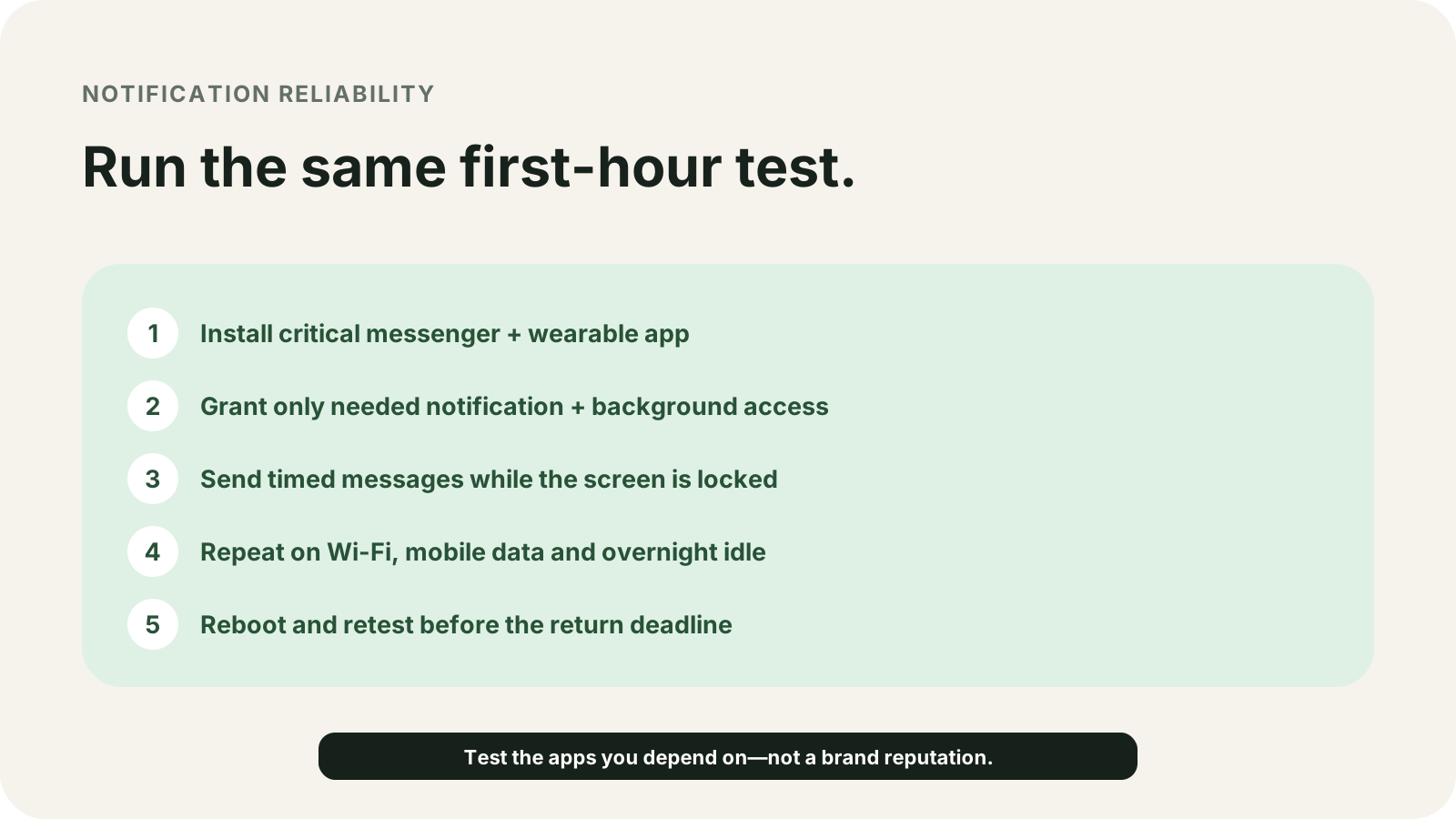
The Xiaomi 14T support page says background autostart is a balance between convenience and resource use. Enabling it for critical apps keeps that experience. Disabling it for unnecessary apps can improve system performance and extend battery life. The printed path is Settings, then Apps, then Permissions, then Background autostart. The note says to leave the switch on for essential system apps and for apps you rely on for notifications. [10] That path is the Xiaomi 14T page. The OxygenOS 14.0 manual says some apps start in the background, using system memory and battery power, and prints Settings, Apps, Auto launch. [5] The OxygenOS 16 launch page does not reprint that menu. After a background change, use what to check when Android notifications stop and how to diagnose Android battery drain.
Scroll horizontally to read the labels in this diagram.
Open the full-size setup diagram
Record four things in the return window: the model name, the sales region, whether the ROM matches the global HyperOS 3 page, and the current security-patch date shown on the phone. The patch date is a reading from your unit. It is not a future end date.
Which phone to take home
Choose the OnePlus when three readings line up. The UK smartphone tab lists that exact name. The stored end month is still ahead of the years you will keep it, using the month-gap formula above. And, if the phone is in Europe or North America, you have read the ColorOS 17 sentence with its blank eligible list. The OxygenOS 16 lab lines stay on the OnePlus 13 footnote unless your model is that phone.
Choose the Xiaomi, REDMI, or POCO phone when the HyperOS 3 global page names that model, the unit is a global version outside the Chinese Mainland, and you can live with a security end date that the FAQ leaves blank. The 2-year line is the typical floor after first shipment. It becomes a year count only after the shipment date is printed for that model.
Set the phone up with how to set up a new Android phone once the model row and the ROM match.
What was checked on 18 October 2026
The sentences above come from the OnePlus notices, the UK security script, the OxygenOS 16 launch page, the OxygenOS 14.0 manual, the HyperOS 3 global page, the Xiaomi security FAQ, the UK MIUI ad page, the MIUI privacy white paper, and the Xiaomi 14T autostart page. The privacy.mi.com FAQ and the Xiaomi security-center policy URL returned shells without the article or the policy table, so those cells stay blank. Library search returned phone-news pages, and no figure was taken from them. No cached SERP row was available, and no new SERP was bought. Month-gap lines are labeled arithmetic. The 48-month hold is a planning assumption.
Frequently Asked Questions
Does OnePlus still use OxygenOS?
The OxygenOS 16 launch page dates the launch event 16 October 2025. The US and Europe notices say that after ColorOS 17 is officially released, eligible existing devices can voluntarily update, and users can choose to stay on OxygenOS. Those notices print no eligible-model list and no ColorOS 17 release date.
How long do OnePlus phones receive security updates?
The UK page pledges a minimum of three (3) years after product launch for smartphones and tablets, and the smartphone tab stores an end date beside each named phone. OnePlus 13 is stored as 2031/01/07. OnePlus 10 Pro is stored as 2026/01/01. A name missing from that tab has a blank end date on this page.
How long do Xiaomi phones receive security updates?
The global FAQ says Xiaomi, REDMI, and POCO typically keep security updates for at least 2 years after first shipment, and that some models receive 3 years or longer, subject to actual conditions. It prints no model name and no end date. A HyperOS 3 soft-release window is a version rollout, not that end date.
Does turning off personalized ads remove Xiaomi ads?
The UK support page says that with personalized ad recommendations off, MIUI system apps still show the same quantity of ads, and those ads are no longer based on personal preferences. The MIUI privacy white paper says non-personalized ads continue. Neither document is the HyperOS 3 feature page. The HyperOS privacy FAQ saved for this page has no article text.
Does the HyperOS 3 global page cover mainland China?
The page says its information applies to global versions of Xiaomi, REDMI, and POCO phones and tablets, plus Xiaomi and REDMI wearables, running HyperOS 3 and above, available outside the Chinese Mainland.
Sources & methodology10 sources
Evidence used for this article. Links open the original source in a new tab.
- Notice of Business Adjustment — US page; no publication date printed; saved 18 October 2026 — OnePlus
- Notice of Business Adjustment — Europe page; no publication date printed; saved 18 October 2026 — OnePlus
- Product Security Update Period — OnePlus UK
- OxygenOS 16 launch page — OnePlus
- OxygenOS 14.0 User Manual — OnePlus
- Xiaomi HyperOS 3 global page — Xiaomi
- How long do Xiaomi phones usually get updated with software/ Security patches? — Xiaomi Global Support
- How to close Ad services? — Xiaomi UK Support
- MIUI Privacy White Paper, section 4.13 Advertisement — Xiaomi Trust Center
- How to switch on/off the Background autostart for APPs on the Xiaomi 14T — Xiaomi Global Support
TasteOfAndroid is responsible for this page. The byline, method and commercial relationships are on the editorial policy and the author page.
Related Articles
Choosing Waterproof Phone Cases: IP Ratings, Seal Condition and Fit
Compare rigid waterproof phone cases and pouches by model fit, manufacturer-rated use, closure condition and controls. Understand the limits of phone barometer checks.
Pocket Casts vs AntennaPod: Choose and Move Your Podcasts
Choose Pocket Casts or AntennaPod by playback controls and sync needs, then move subscriptions with OPML while protecting listening progress and settings.
Xodo vs Flexcil: PDF Annotation and Signing on Android
Study marks, a visual signature, and a signing request are different jobs. Follow the public steps, then reopen a copied PDF. These pages do not name a winner or a price.