
Contents
- How Handset Coupling Rules and Transition Dates Apply to Android Phones
- Acoustic Coupling, Telecoil Coupling, and Volume Control Rules
- How Android Hearing Aid Streaming Protocols Compare
- Protocol Packet Timing and Transport Mechanics
- How Phone Models and Hearing Aid Brands Pair Across Android
- Brand-Specific Pairing and Hands-Free Call Nuances
- Pre-Purchase Verification Checklist and Adapter Fallbacks
- Frequently Asked Questions
- What is the difference between ASHA and Bluetooth LE Audio on Android?
- Which Android phones support Bluetooth LE Audio and Auracast for hearing aids?
- How does Bluetooth Classic differ from ASHA and LE Audio for hearing aid calls?
- Why do some newer phones list conversational gain instead of acoustic and telecoil category numbers?
- Sources
Certain Pixel phones stream media and calls directly to hearing aids over Android Audio Streaming for Hearing Aids (ASHA) or the Bluetooth SIG Hearing Access Profile (HAP), which requires either that both the phone and the hearing aid support ASHA or that both support HAP. The FCC requires phones to be compatible with hearing aids, evaluated per ANSI C63.19; prior to December 4, 2023, phones could show HAC compliance with ANSI C63.19-2011 or ANSI C63.19-2019, and after December 4, 2023, only ANSI C63.19-2019 is accepted for HAC compliance. Android hearing aid audio support uses connection-oriented L2CAP channels (CoC) over Bluetooth Low Energy (BLE) with an elastic buffer of several audio packets to maintain steady audio flow in the presence of packet loss at the expense of latency. Starting in Android 13, the Android system includes built-in support for Bluetooth Low Energy (LE) Audio on compatible devices. Comparing a handset across our Android buying guides starts with separating physical earpiece coupling from wireless streaming support.
How Handset Coupling Rules and Transition Dates Apply to Android Phones
ANSI C63.19-2019 does not use the M and T ratings of ANSI C63.19-2011; instead, the 2019 ANSI Standard requires that phones meet or exceed a single PASS threshold for each test and meet volume control specifications. The table below summarizes the federal acoustic, telecoil, and Bluetooth coupling rules:
Scroll horizontally to view all table columns.
| Verification Dimension | Verified Requirement or Specification |
|---|---|
| Transition date | The FCC requires phones to be compatible with hearing aids, evaluated per ANSI C63.19; prior to December 4, 2023, phones could show HAC compliance with ANSI C63.19-2011 or ANSI C63.19-2019, and after December 4, 2023, only ANSI C63.19-2019 is accepted for HAC compliance. |
| Legacy acoustic and inductive categories | Under ANSI C63.19-2011, a mobile phone is considered hearing aid compatible per the FCC if rated M3 or M4 for acoustic coupling (immunity to radio frequency interference) and T3 or T4 for inductive coupling (telecoil performance). |
| Pass threshold structure | ANSI C63.19-2019 does not use the M and T ratings of ANSI C63.19-2011; instead, the 2019 ANSI Standard requires that phones meet or exceed a single PASS threshold for each test and meet volume control specifications. |
| Conversational gain thresholds | The two-part volume control test requires conversational gain with a hearing aid of ≥ 6 dB, and conversational gain without a hearing aid of ≥ 6 dB (when tested under FCC limited waiver DA 23-914) or ≥ 18 dB (when tested without the waiver). |
| Tested wireless frequency modes | For HAC testing on Pixel phones, limits and test methods only exist for wireless modes that are ≤ 6 GHz, while modes partially or entirely > 6 GHz are not tested. |
| Operating frequency range | The 2019 ANSI Standard applies to wireless handsets across a frequency range of 614 MHz to 6 GHz, compared to the 2011 ANSI Standard’s frequency range of 698 MHz to 6 GHz. |
Acoustic Coupling, Telecoil Coupling, and Volume Control Rules
The 2019 ANSI Standard applies to wireless handsets across a frequency range of 614 MHz to 6 GHz, compared to the 2011 ANSI Standard’s frequency range of 698 MHz to 6 GHz. Extending the lower test boundary from 698 MHz down to 614 MHz adds 84 MHz of low-band spectrum below 698 MHz (calculated by subtracting 614 MHz from 698 MHz).
The following federal definitions govern acoustic coupling, telecoil coupling, and Bluetooth coupling transitions:
- Acoustic coupling definition: Acoustic coupling refers to hearing aid compatibility where handset models couple with hearing aids through the hearing aid’s microphone that amplifies sound and the handsets meet standards for controlling radiofrequency (RF) interference.
- Bluetooth coupling definition: Bluetooth coupling refers to hearing aid compatibility where handset models couple with hearing aids using short range wireless technology that relies on internal chipsets and antennas within the handset model.
- Telecoil and volume control definition: Telecoil coupling (also referred to as inductive coupling) couples handset models with hearing aids through the use of telecoils, while volume control requirements refer to the technical standard established by ANSI/TIA-5050-2018.
- Interim Bluetooth coupling window: Between December 14, 2026, and December 13, 2028, the FCC Bluetooth coupling requirement may be met using either proprietary or non-proprietary Bluetooth coupling technology.
- Non-proprietary Bluetooth requirement: Beginning on December 13, 2028, the FCC Bluetooth coupling requirement may only be met using Bluetooth coupling technology that utilizes a global, low-power wireless technology standard for high-quality audio voice streaming and is a standalone non-proprietary implementation.
- Freely available Bluetooth coupling: Bluetooth SIG confirms in the FCC record that Bluetooth LE Audio, Bluetooth HAP, and the related Bluetooth Auracast coupling technologies are non-proprietary, low energy coupling standards that are freely available.
- Proprietary versus non-proprietary protocols: The FCC notes that Apple and Android handset models use the proprietary Bluetooth coupling technologies MFi and ASHA, respectively, whereas Bluetooth LE Audio, Bluetooth HAP, and Bluetooth Auracast are non-proprietary Bluetooth coupling standards.
How Android Hearing Aid Streaming Protocols Compare
In Android ASHA (CoC over BLE), there is no audio backlink between the central (Android device) and the peripherals (hearing instruments); during a phone call, the central microphones on the phone are used for voice input. Oticon defines hands-free communication as two-way audio where the phone transmits audio or calls wirelessly to the hearing aids and the hearing aids capture and transmit the wearer’s voice to the caller.
Scroll horizontally to view all table columns.
| Protocol or Profile Layer | Verified Architecture and Transport Specification |
|---|---|
| Connection-oriented channel transport | Android hearing aid audio support uses connection-oriented L2CAP channels (CoC) over Bluetooth Low Energy (BLE) with an elastic buffer of several audio packets to maintain steady audio flow in the presence of packet loss at the expense of latency. |
| Voice call microphone path | In Android ASHA (CoC over BLE), there is no audio backlink between the central (Android device) and the peripherals (hearing instruments); during a phone call, the central microphones on the phone are used for voice input. |
| Controller link support | To implement ASHA CoC, central and peripheral Bluetooth systems must implement a compliant BT 4.2 or higher controller (with LE Secure Connections highly recommended) and support at least two simultaneous LE links on the central. |
| Flow control and packet payload | ASHA devices must support LE credit based flow control (BT Vol 3, Part A, Sec 10.1), an MTU and MPS size of at least 167 bytes on CoC with buffering of up to eight packets, and an LE data length extension (BT Vol 6, Part B, Sec 5.1.9) payload of at least 167 bytes. |
| Physical layer bitrate recommendation | AOSP strongly recommends that the central and peripheral support 2M PHY as specified in the BT 5.0 specification; the central must support audio links of at least 64 kbit/s on both 1M and 2M PHYs, and the BLE long range PHY must not be used. |
| Mandatory audio codec parameters | For the ASHA mandatory G.722 @ 16 kHz codec configuration, the bitrate is 64 kbit/s, the connection interval is 20 ms, the CE Length is 5000/3750 us (1M/2M PHY), and the audio payload size is 160 bytes. |
| Platform built-in audio support | Starting in Android 13, the Android system includes built-in support for Bluetooth Low Energy (LE) Audio on compatible devices. |
| Low complexity audio codec | The LC3 codec used in Bluetooth LE Audio provides improved sound clarity at lower data rates for music and speech streaming even in environments with limited wireless bandwidth. |
| Broadcast and codec architecture | Bluetooth LE Audio was initially conceived to enhance hearing aid technology before expanding to consumer audio, and includes Auracast broadcast audio and the Low Complexity Communications Codec (LC3) that delivers audio quality at reduced bitrates to optimize battery usage. |
| Classic Bluetooth hands-free calls | With Bluetooth Classic Audio, hearing aid wearers can use two-way hands-free (hearing and speaking) calls across iOS and a wide range of Android phones, computers, and tablets equipped with Bluetooth Classic. |
Protocol Packet Timing and Transport Mechanics
AOSP ASHA stream setup is based on simulations with an audio frame buffer depth of 8, which makes the network delay in the system equal to eight times the connection interval. Holding 8 audio packets at a 20 ms connection interval produces a network delay of 160 ms (calculated by multiplying 8 packets by 20 ms).
- Volume attenuation byte scale: The ASHA Volume characteristic is a byte between -128 and 0 indicating attenuation from -48 dB to 0 dB, where setting -128 is interpreted as fully muted and -127 is the lowest non-muted volume level (-47.625 dB attenuation).
- Service and characteristic identifiers: The ASHA GATT service uses Service UUID
{0xFDF0}with five characteristic UUIDs:ReadOnlyProperties,AudioControlPoint,AudioStatus,Volume, andLE_PSM_OUT. - Binaural packet sequence number: In ASHA binaural synchronization, each audio packet has an 8-bit sequence number that increments by one after each packet and repeats after 256 audio packets.
- Audio frame sample count: In ASHA audio framing, an audio frame should always match the connection interval in time; for a 20 ms connection interval and a 16 kHz sample rate, the audio frame must contain 320 samples.
- Low energy sleep mode: Bluetooth Low Energy (BLE), available in Android 4.3 and higher, creates short connections to transfer bursts of data and remains in sleep mode when not connected, providing lower bandwidth and reduced power consumption compared to Classic Bluetooth.
Evaluating long-term OS support across handsets in our Android update support analysis helps buyers see which phones receive newer Android releases.
How Phone Models and Hearing Aid Brands Pair Across Android
Google specifies that LE Audio Auracast compatibility on Android includes the Google Pixel 8 series and newer and Samsung flagship devices released since 2023 (Galaxy S23/S24/S25, Z Fold5/6/7), and requires both the phone and headphones must support LE Audio.
The matrix below maps Pixel generations across acoustic, telecoil, and Bluetooth (ASHA/HAP) coupling:
Scroll horizontally to view all table columns.
| Device or Hearing Aid Family | Verified Protocol Support and Operating Requirements |
|---|---|
| Latest foldables and large flagships | Google Pixel 11 Pro Fold (model GZDQ6, FCC ID A4RGZDQ6) supports Acoustic (A: Yes), Telecoil (T: Yes), and Bluetooth coupling (BT: Yes (ASHA; HAP)), with conversational gain of 10.0 w/ aid and 15.0 w/o aid (≤6GHz). |
| Large flagship conversational gain | Google Pixel 11 Pro XL (model GBC0H, FCC ID A4RGBC0H) supports Acoustic (A: Yes), Telecoil (T: Yes), and Bluetooth coupling (BT: Yes (ASHA; HAP)), with conversational gain of 13.7 w/ aid and 19.0 w/o aid (≤6GHz). |
| Flagship pair conversational gain | Google Pixel 11 Pro (G7SWN, FCC ID A4RG7SWN) and Pixel 11 (GPQQ7, FCC ID A4RGPQQ7) both support A: Yes, T: Yes, and BT: Yes (ASHA; HAP), with conversational gain of 14.3 w/ aid and 19.5 w/o aid on Pixel 11 Pro and 14.4 w/ aid and 19.3 w/o aid on Pixel 11. |
| Midrange and foldable pair | Google Pixel 10a (GE1GQ, FCC ID A4RGE1GQ) and Pixel 10 Pro Fold (GU0NP, FCC ID A4RGU0NP) both support A: Yes, T: Yes, and BT: Yes (ASHA; HAP), with conversational gain of 12.0 w/ aid and 18.0 w/o aid on Pixel 10a and 17.2 w/ aid and 17.2 w/o aid on Pixel 10 Pro Fold. |
| Tenth-generation flagship lineup | Google Pixel 10 Pro XL (GUL82, 16.9 w/ aid; 19.1 w/o aid), Pixel 10 Pro (G4QUR, 16.7 w/ aid; 17.3 w/o aid), and Pixel 10 (GLBW0, 16.6 w/ aid; 19.3 w/o aid) all support A: Yes, T: Yes, and BT: Yes (ASHA; HAP). |
| Ninth-generation midrange and fold | Google Pixel 9a (GXQ96, 17.1 w/ aid; 18.5 w/o aid) and Pixel 9 Pro Fold (GGH2X, 19 w/ aid; 18 w/o aid) both support A: Yes, T: Yes, and BT: Yes (ASHA; HAP). |
| Ninth-generation flagship trio | Google Pixel 9 Pro XL (GGX8B), Pixel 9 Pro (GR83Y), and Pixel 9 (G2YBB) all support A: Yes, T: Yes, and BT: Yes (ASHA; HAP), each with conversational gain of 17 w/ aid and 18 w/o aid. |
| Eighth-generation midrange variants | Google Pixel 8a (models G8HHN and GKV4X) supports Acoustic (A: Yes), Telecoil (T: Yes), and Bluetooth coupling (BT: Yes (ASHA; HAP)), with conversational gain of 17 w/ aid and 18 w/o aid on G8HHN and 17 w/ aid and 19 w/o aid on GKV4X. |
| Eighth-generation and seventh-generation midrange | Google Pixel 8 Pro (G1MNW), Pixel 8 (GKWS6, G9BQD), Pixel Fold (G9FPL), and Pixel 7a (G0DZQ, GWKK3) are all rated M3, T4 and list coupling support of A: Yes, T: Yes, and BT: Yes (ASHA; HAP). |
| Seventh-generation and sixth-generation lineup | In Google’s HAC table, Pixel 7 Pro (GE2AE), Pixel 7 (GQML3, GVU6C), Pixel 6a (GB62Z, GX7AS), and Pixel 6 Pro (G8V0U) are rated M3, T4 with BT: Yes (ASHA), while Pixel 6 (G9S9B, GB7N6) is rated M3, T3 with BT: Yes (ASHA). |
| Early Pixel generations | Pixel 3 (G013A) and Pixel 3 XL (G013C) are rated M3, T3 with BT: Yes (ASHA), whereas earlier Pixel 2 (G011A, M4, T3), Pixel 2 XL (G011C, M4, T3), Pixel 1 (G-2PW4100, M4, T4), and Pixel 1 XL (G-2PW2100, M4, T4) have A: Yes and T: Yes but list BT: No for hearing aid Bluetooth coupling. |
Brand-Specific Pairing and Hands-Free Call Nuances
On Android phones and tablets, two-way hands-free communication and direct streaming via Bluetooth LE Audio is available for Oticon Intent, while phones and tablets that do not support Bluetooth LE Audio require an Easy LE Adapter accessory. Buyers weighing flagship handsets in our flagship Pixel and Galaxy hardware comparison or evaluating system menus in our Pixel Android vs. Samsung One UI guide can verify brand pairing behavior below:
- Xiaomi and POCO Auracast support: Google lists specific Xiaomi models (Xiaomi 14T, Xiaomi 14T Pro, Xiaomi 14, Xiaomi 15, Xiaomi 14 Ultra, Xiaomi 15 Ultra, Xiaomi MIX Flip) and POCO models (POCO X6 Pro, POCO F6 Pro, POCO F7 Pro, POCO F7 Ultra) as compatible with LE Audio Auracast.
- Oticon Android OS version thresholds: For Oticon hearing aids on Android, hands-free communication and direct streaming via Bluetooth LE Audio requires an Android device that supports Bluetooth LE Audio with Android 14 or newer installed, while direct streaming via ASHA requires an ASHA-compatible device with Android 10 or newer installed.
- Oticon Windows laptop requirements: For hands-free communication and direct streaming with Oticon Intent on Windows PCs and laptops via Bluetooth LE Audio, the PC must run Windows 11 24H2 or newer and have manufacturer-integrated Bluetooth LE Audio support and drivers.
- GN ReSound Bluetooth version requirement: GN ReSound specifies that Android models marked with a double asterisk (**) support Bluetooth Low Energy Audio including hands-free call functionality, and that LE Audio is compatible with GN devices and mobile devices that have Bluetooth 5.3 or later.
- GN ReSound hearing aid families: GN ReSound lists ReSound Sensia, ReSound Vivia, ReSound Enzo IA, ReSound Savi, and ReSound Nexia as its hearing aids compatible with Bluetooth 5.3+ Android devices supporting the Bluetooth LE Audio protocol.
- Phonak One UI software note: Phonak reports that Samsung Galaxy phones running Android with One UI 6.x may experience Bluetooth disconnections or limited hearing aid functionality caused by the phone software’s handling of Bluetooth audio profiles rather than the hearing aids.
- Oticon midrange Galaxy workaround: Oticon notes that Samsung Galaxy A55 and A56 devices remain compatible with its hearing aids, but some users may experience a known issue where the phone may unexpectedly crash during LE Audio calls; as a workaround, Oticon recommends disabling LE Audio and using ASHA streaming where available.
- Oticon CROS opposite-ear dependency: Oticon CROS does not directly connect to phones or tablets and is dependent on the hearing aid on the opposite ear for streaming compatibility.
Pre-Purchase Verification Checklist and Adapter Fallbacks
The Oticon Easy LE Adapter is a USB-C device that enables Bluetooth LE Audio on phones, tablets, and computers lacking native LE Audio support, but most phones and tablets with a 3.5 mm jack will not work because manufacturers often route audio through the 3.5 mm jack port instead of USB-C.
Follow these steps to verify an Android handset before purchase or during return-window testing:
- Check default Acoustic Coupling mode on Pixel: In Acoustic Coupling (‘M’) mode, the hearing aid receives audio from the Pixel phone through the hearing aid’s built-in microphones; by default, Pixel phones are in Acoustic Coupling mode and have Hearing aid compatibility mode turned OFF.
- Enable Telecoil mode in Accessibility settings: To use telecoil (‘T’ or inductive) coupling mode on a Pixel phone, the user must set the hearing aid to ‘T’ and turn on Hearing Aid Compatibility (HAC) mode in Settings > Accessibility > Hearing devices > Hearing aid compatibility.
- Check the dedicated Pixel HAC table rather than the general spec sheet: Pixel 10a lists conversational gain of 12.0 dB with a hearing aid and 18.0 dB without a hearing aid under DA 23-914 without naming ASHA or HAP on the main specification page; other models use similarly terse wording with different gain pairs.
- Verify whether the phone has an analog audio port before buying an adapter: The Oticon Easy LE Adapter is a USB-C device that enables Bluetooth LE Audio on phones, tablets, and computers lacking native LE Audio support, but most phones and tablets with a 3.5 mm jack will not work because manufacturers often route audio through the 3.5 mm jack port instead of USB-C.
- Confirm Android OS version for Oticon LE Audio versus ASHA: For Oticon hearing aids on Android, hands-free communication and direct streaming via Bluetooth LE Audio requires an Android device that supports Bluetooth LE Audio with Android 14 or newer installed, while direct streaming via ASHA requires an ASHA-compatible device with Android 10 or newer installed.
Frequently Asked Questions
What is the difference between ASHA and Bluetooth LE Audio on Android?
In Android ASHA (CoC over BLE), there is no audio backlink between the central (Android device) and the peripherals (hearing instruments); during a phone call, the central microphones on the phone are used for voice input. For the ASHA mandatory G.722 @ 16 kHz codec configuration, the bitrate is 64 kbit/s, the connection interval is 20 ms, the CE Length is 5000/3750 us (1M/2M PHY), and the audio payload size is 160 bytes. Bluetooth LE Audio was initially conceived to enhance hearing aid technology before expanding to consumer audio, and includes Auracast broadcast audio and the Low Complexity Communications Codec (LC3) that delivers audio quality at reduced bitrates to optimize battery usage. The FCC notes that Apple and Android handset models use the proprietary Bluetooth coupling technologies MFi and ASHA, respectively, whereas Bluetooth LE Audio, Bluetooth HAP, and Bluetooth Auracast are non-proprietary Bluetooth coupling standards.
Which Android phones support Bluetooth LE Audio and Auracast for hearing aids?
Google specifies that LE Audio Auracast compatibility on Android includes the Google Pixel 8 series and newer and Samsung flagship devices released since 2023 (Galaxy S23/S24/S25, Z Fold5/6/7), and requires both the phone and headphones must support LE Audio. Google lists specific Xiaomi models (Xiaomi 14T, Xiaomi 14T Pro, Xiaomi 14, Xiaomi 15, Xiaomi 14 Ultra, Xiaomi 15 Ultra, Xiaomi MIX Flip) and POCO models (POCO X6 Pro, POCO F6 Pro, POCO F7 Pro, POCO F7 Ultra) as compatible with LE Audio Auracast.
How does Bluetooth Classic differ from ASHA and LE Audio for hearing aid calls?
With Bluetooth Classic Audio, hearing aid wearers can use two-way hands-free (hearing and speaking) calls across iOS and a wide range of Android phones, computers, and tablets equipped with Bluetooth Classic. Phonak reports that Samsung Galaxy phones running Android with One UI 6.x may experience Bluetooth disconnections or limited hearing aid functionality caused by the phone software’s handling of Bluetooth audio profiles rather than the hearing aids.
Why do some newer phones list conversational gain instead of acoustic and telecoil category numbers?
ANSI C63.19-2019 does not use the M and T ratings of ANSI C63.19-2011; instead, the 2019 ANSI Standard requires that phones meet or exceed a single PASS threshold for each test and meet volume control specifications. The two-part volume control test requires conversational gain with a hearing aid of ≥ 6 dB, and conversational gain without a hearing aid of ≥ 6 dB (when tested under FCC limited waiver DA 23-914) or ≥ 18 dB (when tested without the waiver).
Sources
- Federal wireless handset acoustic and inductive coupling rules in the Code of Federal Regulations.
- Federal Register rulemakings covering wireless hearing aid compatibility transition schedules and volume control mandates.
- Android Open Source Project technical documentation for Audio Streaming for Hearing Aids over Bluetooth Low Energy.
- Android Open Source Project platform documentation for Bluetooth Low Energy Audio profiles and broadcast audio.
- Android developer platform release notes covering built-in hearing aid audio support.
- Google Pixel hardware documentation covering wireless hearing aid compatibility and audio streaming specifications.
- Bluetooth Special Interest Group technical overview for Low Energy Audio, the Low Complexity Communication Codec, and the Hearing Access Profile.
- Manufacturer phone compatibility documentation from Oticon, Phonak, ReSound, and Audio Service.
TasteOfAndroid is responsible for this page. The byline, method and commercial relationships are on the editorial policy and the author page.
Related Articles
Wi-Fi 6E Versus Wi-Fi 7 on Android: 6 GHz Band and Channel Width Checks
Introduced in 2024, Wi-Fi 7 enhances performance across the 2.4 GHz, 5 GHz, and 6 GHz bands, delivering high throughput, lower latency, and greater reliability.
USB-C PD PPS Versus Fixed PDO Charging Negotiation on Android
Match your Android phone to a charger's PPS voltage range, current limit, port and cable. Understand fixed PDO negotiation and why heat needs a separate check.
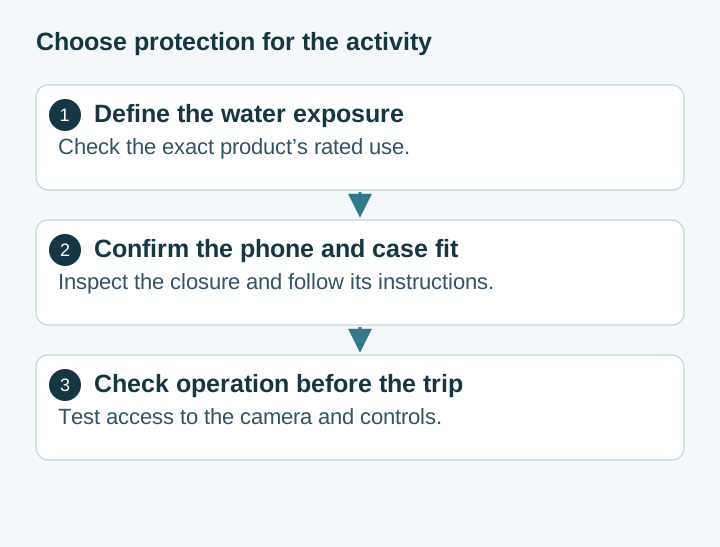
Choosing Waterproof Phone Cases: IP Ratings, Seal Condition and Fit
Compare rigid waterproof phone cases and pouches by model fit, manufacturer-rated use, closure condition and controls. Understand the limits of phone barometer checks.