
Contents
- How Wireless Generations Compare on Android
- Why Generation Badges Do Not Guarantee Upper-Band Channels on Android
- How Channel Width Caps and Flagship Tiers Split Android Phones
- How Regional Variants and Spectrum Rules Change What Your Phone Can Use
- Regional Smartphone Variant Splits
- Global Spectrum Allocation Tiers
- Federal Channel Width and Client Transmit Power Rules
- How Android Verifies Bands, Wide Channels, and Multi-Link Operation
- Driver, Association, and Multi-Link Architecture
- Android Developer Framework Constants and Methods
- Pre-Purchase Verification Checklist
- Frequently Asked Questions
- Does every new flagship phone include upper-band support and wide channels?
- Why do some midrange Android phones connect with narrower channel width?
- Why does an indoor smartphone drop the upper band earlier than the router?
- Which Android release is needed for multi-link negotiation?
- Sources
Introduced in 2024, Wi-Fi 7 enhances performance across the 2.4 GHz, 5 GHz, and 6 GHz bands, delivering high throughput, lower latency, and greater reliability. In the 6 GHz band, 320 MHz channels provide twice the throughput of Wi-Fi 6, enabling multigigabit Wi-Fi device speeds. When comparing Wi-Fi 6E versus Wi-Fi 7 on Android for 6 GHz band and channel checks, Wi-Fi Alliance 2026 chipset shipment data lists 1.4B Wi-Fi 7 chipset shipments in 2026, 2.2B Wi-Fi 6 chipset shipments in 2026, and 1.4B 6 GHz chipset shipments in 2026 (Wi-Fi 6E & tri-band Wi-Fi 7).
Before upgrading your handset or home router, walk through the specification checks below alongside our other Android phone buying guides.
How Wireless Generations Compare on Android
Checking the generation name alone is not enough when comparing Android spec sheets. The table below summarizes the operating bands, channel widths, modulation gains, and Android operating system support.
Scroll horizontally to view all table columns.
| Specification Check | Published Capability |
|---|---|
| Legacy and new band support | Wi-Fi 6 also introduced Wi-Fi in the 6 GHz band in addition to the 2.4 GHz and 5 GHz bands available in previous generations. |
| Wide channel utilization and power saving | 160 MHz channel utilization capability increases bandwidth to deliver greater performance with low latency, and Target wake time (TWT) significantly improves network efficiency and device battery life. |
| Tri-band scope and release year | Introduced in 2024, Wi-Fi 7 enhances performance across the 2.4 GHz, 5 GHz, and 6 GHz bands. |
| Doubling wide channel throughput | 320 MHz channels available in the 6 GHz band provide twice the throughput of Wi-Fi 6, enabling multigigabit Wi-Fi device speeds. |
| Channel bandwidth ratio | Dividing the 320 MHz channel width by 160 MHz yields a 2x channel bandwidth ratio. |
| Quadrature amplitude modulation gain | 4K quadrature amplitude modulation mode (4K QAM) achieves 20% higher transmission rates than Wi-Fi 6 1024 QAM for greater efficiency. |
| Block acknowledgement and resource scheduling | 512 Compressed Block Ack improves efficiency and reduces overhead, while Multiple RUs to a single STA improves flexibility for spectrum resource scheduling to enhance spectrum efficiency. |
| Multi-link traffic load balancing | Multi-link operation supports more efficient load balancing of traffic among links, resulting in increased throughput and enhanced reliability. |
| Android operating system support | For devices running Android 13 or higher, Android supports the Wi-Fi 7 (IEEE 802.11be) standard, including baseline and multi-link operation (MLO) features. |
Why Generation Badges Do Not Guarantee Upper-Band Channels on Android
Router marketing and chipset headlines frequently bundle every optional radio feature under one generation label, whereas smartphone radios depend on tri-band hardware, antenna stream counts, and channel-width limits.
- Chipset shipment split: Wi-Fi Alliance 2026 chipset shipment data lists 1.4B Wi-Fi 7 chipset shipments in 2026, 2.2B Wi-Fi 6 chipset shipments in 2026, and 1.4B 6 GHz chipset shipments in 2026 (Wi-Fi 6E & tri-band Wi-Fi 7).
- Available spectrum and wide channel count: Ezurio notes the 6 GHz band (roughly 5.925–7.125 GHz in the US) adds up to 1200 MHz of new spectrum, allowing up to seven 160 MHz-wide channels versus at most two in 5 GHz.
- Bandwidth and modulation speed multiplier: NETGEAR states that greater channel bandwidth (320MHz) and more data density (4K QAM) account for the 2.4x improvement in WiFi speeds between WiFi 6 and WiFi 7.
- Theoretical speed ceiling: eero states that with maximum theoretical speeds reaching up to 46 Gbps, Wi-Fi 7 doubles the top speed in 6 GHz compared to Wi-Fi 6E or Wi-Fi 6.
How Channel Width Caps and Flagship Tiers Split Android Phones
Android manufacturers segment wireless capabilities both between midrange and flagship lines and between base and Pro or Ultra models within the same generation. When weighing an older premium handset against a newer budget model, read this section alongside our new midrange phone versus older flagship buying guide.
Scroll horizontally to view all table columns.
| Device Tier and Lineup | Published Wireless Specification |
|---|---|
| Google Pro-tier Pixel specification | Google’s Pro-tier Pixel specification lists Wi-Fi 7 (802.11be) with 2.4GHz, 5GHz, 6GHz, 2x2 MIMO. |
| Google base-model Pixel specification | Google’s base-model Pixel specification lists Wi-Fi 6E (802.11ax) with 2.4GHz, 5GHz, 6GHz, 2x2 MIMO. |
| Google midrange A-series specification | US (PR), CA, UK, EU, AU, JP, TW, and SG list Wi-Fi 6E (802.11ax) with 2.4 GHz + 5 GHz + 6 GHz, HE80, MIMO, while IN lists Wi-Fi 6 (802.11ax) with 2.4 GHz + 5 GHz, HE80, MIMO. |
| Google wide-channel flagship specification | US (PR), CA, UK, EU, AU support Wi-Fi 6E (802.11ax) with 2.4GHz+5GHz+6GHz, HE160, MIMO, while TW, JP, SG, IN support Wi-Fi 6 (802.11ax) with 2.4GHz+5GHz, HE160, MIMO. |
| Samsung Ultra flagship tier | In Samsung’s specification table, the Ultra tier supports 5G, LTE, Wi-Fi 7, Wi-Fi Direct, and Bluetooth v 5.3 on Android 14 (One UI 6.1). |
| Samsung base and Plus flagship tiers | In Samsung’s specification table, the base and Plus tiers list 5G, LTE, Wi-Fi 6E, Wi-Fi Direct, and Bluetooth v 5.3 on Android 14 (One UI 6.1). |
| Samsung next-generation flagship lineup | In Samsung’s specification table, the Galaxy S26 lists 5G (sub6), LTE, Wi-Fi 7, Wi-Fi Direct, Bluetooth v 5.4, and UWB, and the Galaxy S26+ lists 5G (sub6, mmW), LTE, Wi-Fi 7, Wi-Fi Direct, Bluetooth v 6.0, and UWB, on Android 16 (One UI 8.5). |
How Regional Variants and Spectrum Rules Change What Your Phone Can Use
Even when a smartphone hardware family supports tri-band connectivity in North America and Europe, regional variants and national spectrum allocations determine whether the upper band is enabled. If you are considering an imported handset, pair these checks with our Global Version versus China Version phone buying guide.
Regional Smartphone Variant Splits
- Flagship regional fallback: Supported 6GHz markets list Wi-Fi 7 (802.11be) with 2.4GHz+5GHz+6GHz, 2x2 + 2x2 MIMO, while IN lists Wi-Fi 6 (802.11ax) with 2.4GHz+5GHz, HE160, MIMO.
- Three-tier regional split: Regional tiers list Wi-Fi 7 (802.11be) with 2.4GHz+5GHz+6GHz, 2x2+2x2 MIMO, Wi-Fi 6E (802.11ax) with 2.4GHz+5GHz+6GHz, 2x2+2x2 MIMO in JP, and Wi-Fi 6 (802.11ax) with 2.4GHz+5GHz, HE160, and MIMO in TW, SG, and IN.
- Foldable regional band omission: On Pixel Fold, US, UK, DE list Wi-Fi 6E (802.11ax) with 2.4 G+5G Hz+6 GHz, HE160, MIMO, whereas JP lists Wi-Fi 6E (802.11ax) with 2.4 G+5 GHz, HE160, MIMO.
Global Spectrum Allocation Tiers
Wi-Fi Alliance tracks global regulations enabling 6 GHz spectrum for Wi-Fi across two adoption tiers: Adopted 5925/5945-6425 MHz and Adopted 5925-7125 MHz.
Scroll horizontally to view all table columns.
| Region or Country | Adopted Frequency Range |
|---|---|
| United States and United Kingdom | In the Wi-Fi Alliance Adopted table, United Kingdom lists 5925/5945-6425 MHz while United States lists 5925-7125 MHz. |
| South Korea | In the Wi-Fi Alliance Adopted table, South Korea lists 5925-7125 MHz. |
| Japan | In the Wi-Fi Alliance Adopted table, Japan lists 5925/5945-6425 MHz. |
| India | In the Wi-Fi Alliance Adopted table, India lists 5925/5945-6425 MHz. |
| Australia | Australia allowed Wi-Fi operations in the 6425-6585 MHz band in addition to 5925-6425 MHz. |
Federal Channel Width and Client Transmit Power Rules
In the United States, federal rules govern both channel bandwidth and how much transmit power a client smartphone can use relative to an access point:
- Unlicensed spectrum order: Making an additional 1200 megahertz of 6 GHz spectrum available for unlicensed use enabled the use of 160-megahertz channels.
- Low-power indoor wide-channel order: In authorizing use of the entire 6 GHz band for LPI use, the Commission provided opportunities for unlicensed operations to transmit using up to 320 megahertz wide channels.
- Codified transmitter bandwidth rule: Under 47 CFR 15.407(a)(11), the maximum transmitter channel bandwidth for U-NII devices in the 5.925-7.125 GHz band is 320 megahertz.
Scroll horizontally to view all table columns.
| Device Category | Power Spectral Density and Output Limit |
|---|---|
| Standard power access point and fixed client device | Under 47 CFR 15.407(a)(4), maximum power spectral density must not exceed 23 dBm e.i.r.p in any 1-megahertz band, and maximum e.i.r.p. over the frequency band of operation must not exceed 36 dBm. |
| Client under standard power access point | Under 47 CFR 15.407(a)(8)(i), client devices under a standard power access point must not exceed 17 dBm e.i.r.p. in any 1-megahertz band, the maximum e.i.r.p. over the frequency band of operation must not exceed 30 dBm, and the device must limit its power to no more than 6 dB below the access point. |
| Indoor access point | Under 47 CFR 15.407(a)(5), indoor access point maximum power spectral density must not exceed 5 dBm e.i.r.p. in any 1-megahertz band, and maximum e.i.r.p. over the frequency band of operation must not exceed 30 dBm. |
| Client under indoor access point | Under 47 CFR 15.407(a)(8)(ii), client devices operating under an indoor access point must not exceed −1 dBm e.i.r.p. in any 1-megahertz band, and the maximum e.i.r.p. over the frequency band of operation must not exceed 24 dBm. |
| Portable low-power category | Under 47 CFR 15.407(a)(9), for very low power devices operating in the 5.925-7.125 GHz band, maximum power spectral density must not exceed −5 dBm e.i.r.p in any 1-megahertz band and maximum e.i.r.p must not exceed 14 dBm. |
Worked power-offset calculation: Subtracting the 24 dBm indoor client ceiling from the 30 dBm indoor access point ceiling leaves a 6 dB transmit power gap.
How Android Verifies Bands, Wide Channels, and Multi-Link Operation
Driver, Association, and Multi-Link Architecture
- Driver capability attribute check: When checking device Wi-Fi 7 support via
NL80211_CMD_GET_WIPHY, if theNL80211_BAND_IFTYPE_ATTR_EHT_CAP_PHYattribute is in the driver response, the device is assumed to support Wi-Fi 7. - Connection association check: To determine STA connection mode, the AIDL layer checks whether EHT Capability IE is in both
AssocReqandAssocRspduring connection setup. - Throughput prediction scoring: In Android 13,
ThroughputPredictoruses AP support of Wi-Fi 7 (802.11be) and support of 320 MHz channel width in its calculation. - Simultaneous band combinations: In AOSP MLO network selection, simultaneous band combinations (GHz) include 2.4, 5, 6, 2.4 x 5, 2.4 x 6, and 5 x 6.
- Single-radio contention versus multi-link scoring: In AOSP MLO network scoring, chips report
maxMloStrLinkCountandmaxMloAssociationLinkCount, where multiple links can operate on a single radio using Enhanced Multi-Link Single Radio (eMLSR). - Dual-connection hardware recommendation: For Wi-Fi STA/STA concurrency, the firmware must support all channel and band combinations for both connections, and AOSP recommends using a 2x2+2x2 DBS capable Wi-Fi chip.

Android Developer Framework Constants and Methods
Diagnostic apps and system checks read the following Android framework constants and methods to confirm supported bands, channel widths, and active links:
Scroll horizontally to view all table columns.
| Android Class and Symbol | Framework Definition |
|---|---|
ScanResult.CHANNEL_WIDTH_160MHZ |
In Android ScanResult (added in API level 23), CHANNEL_WIDTH_160MHZ has Constant Value 3 (0x00000003) and indicates AP Channel bandwidth is 160 MHZ. |
WifiManager.is6GHzBandSupported() |
Added in API level 30, is6GHzBandSupported checks if the chipset supports 6GHz band. |
ScanResult.WIFI_BAND_6_GHZ |
In Android ScanResult, WIFI_BAND_6_GHZ (Constant Value 8, 0x00000008, Wi-Fi 6 GHz band) was added in API level 31. |
ScanResult.CHANNEL_WIDTH_320MHZ |
In Android ScanResult, CHANNEL_WIDTH_320MHZ (Constant Value 5, 0x00000005, AP Channel bandwidth is 320 MHZ) was added in API level 33. |
ScanResult.WIFI_STANDARD_11BE |
In Android ScanResult, WIFI_STANDARD_11BE (Wi-Fi 802.11be, Constant Value 8, 0x00000008) was added in API level 33. |
MloLink.getLinkId() |
In Android MloLink, getLinkId returns valid values 0-15, as described in IEEE 802.11be Specification, section 9.4.2.295b.2. |
WifiInfo.getAssociatedMloLinks() |
In Android WifiInfo, getAssociatedMloLinks returns the associated Multi-Link Operation (MLO) Links for Wi-Fi 7 access points when getWifiStandard() returns ScanResult.WIFI_STANDARD_11BE. |
WifiManager.isTidToLinkMappingNegotiationSupported() |
Added in API level 34, isTidToLinkMappingNegotiationSupported returns boolean true if the device supports TID-To-Link Mapping Negotiation. |
Pre-Purchase Verification Checklist
Run through these four checks in order before paying for a smartphone or upgrading your wireless router:
- Confirm regional band availability for your country code: Supported 6GHz markets list Wi-Fi 7 (802.11be) with 2.4GHz+5GHz+6GHz, 2x2 + 2x2 MIMO, while IN lists Wi-Fi 6 (802.11ax) with 2.4GHz+5GHz, HE160, MIMO.
- Inspect the channel-width code on midrange phones: US (PR), CA, UK, EU, AU, JP, TW, and SG list Wi-Fi 6E (802.11ax) with 2.4 GHz + 5 GHz + 6 GHz, HE80, MIMO, while IN lists Wi-Fi 6 (802.11ax) with 2.4 GHz + 5 GHz, HE80, MIMO.
- Check whether your country opened the full band or only the lower band: In the Wi-Fi Alliance Adopted table, United Kingdom lists 5925/5945-6425 MHz while United States lists 5925-7125 MHz.
- Verify multi-link radio concurrency and framework support: In AOSP MLO network scoring, chips report
maxMloStrLinkCountandmaxMloAssociationLinkCount, where multiple links can operate on a single radio using Enhanced Multi-Link Single Radio (eMLSR).
For more hardware comparisons and pre-purchase checklists, explore our complete collection of Android buying guides.
Frequently Asked Questions
Does every new flagship phone include upper-band support and wide channels?
Wi-Fi Alliance 2026 chipset shipment data lists 1.4B Wi-Fi 7 chipset shipments in 2026, 2.2B Wi-Fi 6 chipset shipments in 2026, and 1.4B 6 GHz chipset shipments in 2026 (Wi-Fi 6E & tri-band Wi-Fi 7).
Why do some midrange Android phones connect with narrower channel width?
160 MHz channel utilization capability increases bandwidth to deliver greater performance with low latency, and Target wake time (TWT) significantly improves network efficiency and device battery life. On midrange hardware, US (PR), CA, UK, EU, AU, JP, TW, and SG list Wi-Fi 6E (802.11ax) with 2.4 GHz + 5 GHz + 6 GHz, HE80, MIMO, while IN lists Wi-Fi 6 (802.11ax) with 2.4 GHz + 5 GHz, HE80, MIMO.
Why does an indoor smartphone drop the upper band earlier than the router?
Under 47 CFR 15.407(a)(5), indoor access point maximum power spectral density must not exceed 5 dBm e.i.r.p. in any 1-megahertz band, and maximum e.i.r.p. over the frequency band of operation must not exceed 30 dBm. Under 47 CFR 15.407(a)(8)(ii), client devices operating under an indoor access point must not exceed −1 dBm e.i.r.p. in any 1-megahertz band, and the maximum e.i.r.p. over the frequency band of operation must not exceed 24 dBm.
Which Android release is needed for multi-link negotiation?
Added in API level 34, isTidToLinkMappingNegotiationSupported returns boolean true if the device supports TID-To-Link Mapping Negotiation.
Sources
- Wi-Fi Alliance — Wireless MAC and PHY Certification Overview
- Wi-Fi Alliance — Global Spectrum Regulations Tracker
- Electronic Code of Federal Regulations and Cornell Legal Information Institute — Unlicensed National Information Infrastructure Technical Requirements
- Federal Communications Commission — Unlicensed Spectrum Report and Order Series
- Android Open Source Project — Wireless Architecture and Dual Station Concurrency Documentation
- Android Developers — Wireless Framework API Reference (ScanResult, WifiManager, MloLink, and WifiInfo)
- Google Pixel Help — Pixel Phone Hardware Technical Specifications
- Samsung Newsroom — Galaxy Series Official Hardware Specification Tables
- Ezurio — Wireless Generation Technical Comparison
- NETGEAR — Wireless Bandwidth and Modulation Technical Guide
- eero — Mesh Wireless Architecture Comparison
TasteOfAndroid is responsible for this page. The byline, method and commercial relationships are on the editorial policy and the author page.
Related Articles
USB-C PD PPS Versus Fixed PDO Charging Negotiation on Android
Match your Android phone to a charger's PPS voltage range, current limit, port and cable. Understand fixed PDO negotiation and why heat needs a separate check.
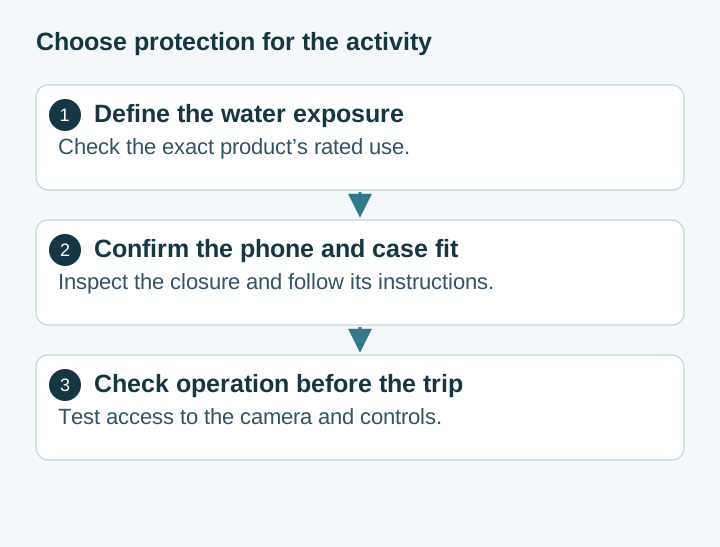
Choosing Waterproof Phone Cases: IP Ratings, Seal Condition and Fit
Compare rigid waterproof phone cases and pouches by model fit, manufacturer-rated use, closure condition and controls. Understand the limits of phone barometer checks.
Pocket Casts vs AntennaPod: Choose and Move Your Podcasts
Choose Pocket Casts or AntennaPod by playback controls and sync needs, then move subscriptions with OPML while protecting listening progress and settings.