
Contents
- What Does Digital Zoom Mean on a Camera?
- Optical Zoom vs Digital Zoom: Which Is Better?
- How Does Hybrid Zoom Compare With Optical Zoom?
- Is Sensor Crop Different From Digital Zoom?
- Which Is Better, a Zoom Lens or Wide Lens?
- How Do Periscope Lenses and Sensor Size Work?
- Why Periscope Telephoto Lenses Fold Light by 90 Degrees
- How Phone Camera Sensor Size Shapes Reach and Noise
- How Should Buyers Verify Smartphone Zoom Specs?
- Frequently Asked Questions
- Does digital zoom increase a phone camera’s optical resolution?
- Do smartphones with optical zoom have a moving zoom lens?
- Is a 2x sensor crop the same as upscaled digital zoom?
- Why do flagship phones use 90-degree periscope telephoto lenses?
- Does a 1-inch or 1/2.7-inch phone camera sensor measure that size across?
- Sources
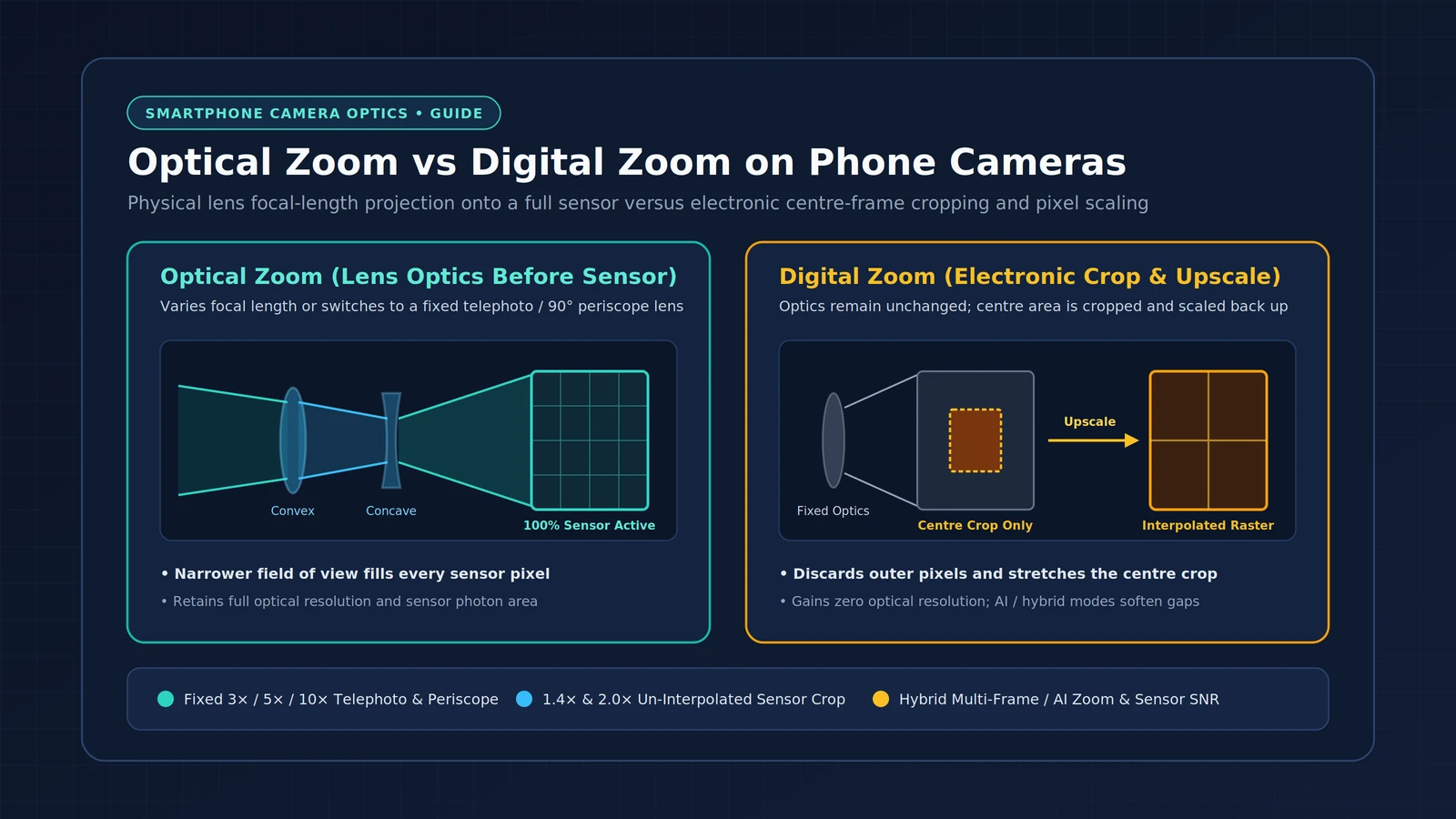
In optical zoom vs digital zoom on a smartphone camera, optical zoom changes physical focal length through camera lens elements or switches to a dedicated fixed telephoto or 90-degree periscope lens across the full sensor, whereas digital zoom electronically crops a smaller centre area and scales it up without gaining optical resolution.
Because camera angle of view is governed by both physical lens focal length and the active sensor area used in a given shooting mode, multi-camera phones blend several techniques across their zoom slider. Higher-end phones step between fixed-focal-length wide and 3× or 5× telephoto cameras, fill intermediate steps with un-interpolated centre-sensor crops, and apply computational or artificial-intelligence hybrid zoom past their longest physical lens. Spec-sheet camera checks sit alongside our other Android phone buying guides.
What Does Digital Zoom Mean on a Camera?
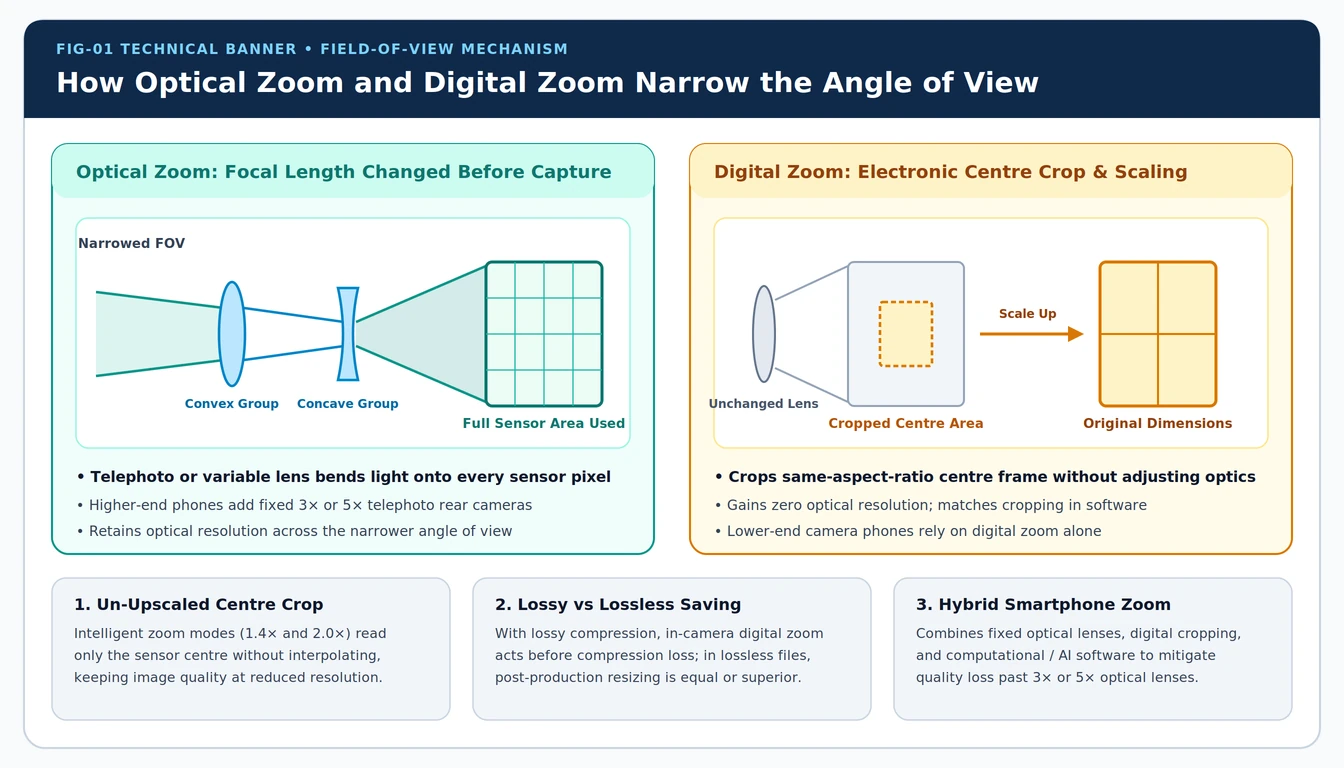
Digital zoom is an electronic method that narrows the angle of view of a photo or video by cropping an image down to a smaller central area with the same aspect ratio and scaling it back up to the original dimensions without adjusting the camera optics, gaining zero optical resolution.
As documented in Wikipedia’s overview of digital zoom, emulating a longer focal length by cropping and enlarging a captured frame produces lower optical resolution than optical zoom and yields the same optical effect as cropping and enlarging the image in computer software. Some optical zoom cameras engage digital zoom automatically once the lens reaches its longest optical focal length, whereas professional cameras generally omit digital zoom. Modern cameras and phones may also apply computationally expensive algorithms that sometimes involve artificial intelligence to refine digitally zoomed output.
File-saving compression determines whether zooming inside the camera offers any advantage over cropping later:
- Lossy compression formats: In cameras that apply lossy compression, in-camera digital zoom can enlarge the image before detail is lost to compression.
- Lossless formats: In cameras that save a lossless format, resizing in post-production yields results equal or superior to in-camera digital zoom.
Optical Zoom vs Digital Zoom: Which Is Better?
Optical zoom produces higher optical resolution than digital zoom because camera lens elements narrow the angular field of view across the entire active sensor rather than stretching a cropped image patch, though variable-focal-length zoom lenses add mechanical size, weight, and maximum-aperture resolution compromises compared with fixed prime lenses.
According to Wikipedia’s reference on zoom lenses, a zoom lens is an optical assembly of lens elements whose focal length and angle of view can be varied, unlike a fixed-focal-length prime lens. A true optical zoom lens is a parfocal lens that maintains focus while its focal length changes, while most consumer zoom lenses are nearly parfocal. Zoom lenses are rated by the ratio of their longest to shortest focal length—for instance, a lens spanning 100 mm to 400 mm carries a 4:1 or 4× zoom ratio.
Keeping the full sensor active also protects low-light image quality: for equal exposures, quantum efficiency, and pixel count, shot-noise signal-to-noise ratio between two sensors scales in proportion to the square root of sensor area, and at identical f-numbers it increases linearly with pixel pitch. Variable-focal-length zoom assemblies still carry real optical trade-offs, including added complexity, reduced resolution at maximum aperture, extra weight and dimensions, slower aperture speed, autofocus compromises, and close-focus breathing where focusing from infinity to medium close-up at the extreme telephoto end of a large-ratio zoom lens can reduce apparent focal length by more than half.
The table below compares all four zoom approaches encountered on smartphone specification sheets:
Scroll horizontally to view all table columns.
| Zoom Method | Optical Lens Change | Active Sensor Area | Output Resolution & Noise Behavior | Typical Smartphone Role |
|---|---|---|---|---|
| Optical zoom (variable or fixed telephoto / periscope) | Varied lens assembly or separate fixed telephoto / 90° periscope lens | Full active sensor of the selected camera module | Preserves full optical resolution; SNR scales with square root of sensor area | Dedicated 3×, 5×, or 10× rear telephoto modules on higher-end phones |
| Centre-sensor crop (Intelligent / Smart / Safe Zoom) | Camera optics unchanged | Cropped central area of the image sensor | Un-interpolated output avoids upscaling deterioration at reduced dimensions or lower video resolution | 1.4× and 2.0× photo modes; 2160p sensor cropped to 2× 1080p, 3× 720p, or 4.5× 480p video |
| Smartphone hybrid zoom | Combines fixed optical lenses with digital cropping | Full telephoto sensor at native step; cropped sensor between or past fixed lenses | Software and AI processing mitigate quality loss past physical 3× or 5× lens limits | Intermediate zoom steps and magnifications beyond 3× or 5× optical telephoto |
| Standard upscaled digital zoom | Camera optics unchanged | Smaller cropped centre region with matching aspect ratio | Scaled back to original raster dimensions with zero optical resolution gain | Sole zoom method on lower-end camera phones and extreme slider multipliers |
How Does Hybrid Zoom Compare With Optical Zoom?
Most camera phones advertised with optical zoom actually pair separate fixed-focal-length cameras with digital cropping in a hybrid system, combining 3× or 5× optical telephoto lenses, digital zoom, and software or artificial-intelligence processing to mitigate quality loss when zooming past each lens’s physical focal length.
Lower-end camera phones rely on digital zoom alone and omit optical zoom hardware, whereas many higher-end phones add rear cameras with fixed telephoto lenses that simulate optical zoom. Because each rear camera has a fixed focal length rather than a continuous variable barrel, pinching past a dedicated 3× or 5× optical telephoto lens switches the camera back toward digital cropping, where hybrid zoom blends optical capture, digital zoom, and computational processing to soften the drop in detail. When weighing whether an older flagship’s dedicated telephoto camera justifies a shorter remaining software support window against a newer budget handset, pair these camera checks with our analysis of a new mid-range phone vs an older flagship.
Is Sensor Crop Different From Digital Zoom?
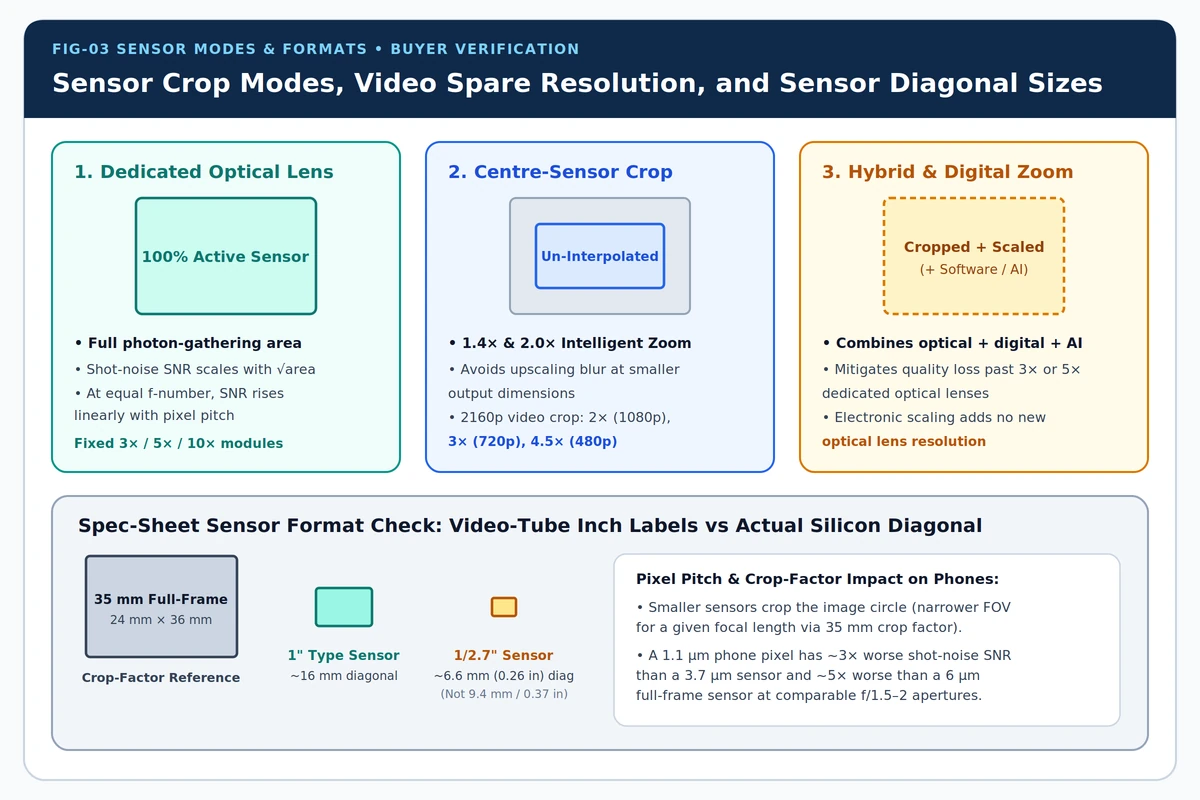
Centre-sensor crop modes differ from standard upscaled digital zoom because they read only the central region of the image sensor and save reduced output dimensions without interpolating back to full raster resolution, avoiding upscaling blur while still using a smaller active sensor area than a full-sensor lens.
Camera and sensor manufacturers market un-interpolated centre-sensor cropping under several names, including Smart Zoom (Sony), Safe Zoom (Canon), Sensor Crop (Cisco), and Intelligent Zoom (Panasonic). Many cameras provide 1.4× and 2.0× intelligent zoom options that read only the centre of the sensor without interpolating back to original dimensions, preserving image quality at reduced width, height, and file size.
Mobile phone cameras apply the same principle to achieve lossless digital zoom during video recording whenever the recorded video frame sits well below the sensor’s total pixel count. On a 2160p image sensor, cropping spare sensor resolution without upscaling supports up to 2× lossless digital zoom for 1080p video recording, 3× for 720p video, and 4.5× for 480p video. Even without interpolation blur, however, narrowing the active area on a small-pixel phone sensor still limits light collection: at comparable f/1.5–2 apertures, a cell phone sensor with 1.1 μm pixels already has roughly 3 times worse shot-noise SNR than a 3.7 μm interchangeable-lens sensor and 5 times worse than a 6 μm full-frame sensor.
Which Is Better, a Zoom Lens or Wide Lens?
Neither lens type replaces the other because they control opposite ends of the field of view: wide-angle lenses capture a broader scene than a normal lens, long-focus telephoto lenses narrow the angle of view for distant subjects, and fixed prime lenses deliver higher optical quality than variable zooms.
Normal zoom lenses on dedicated cameras span a continuous range from wide-angle to long-focus telephoto, trading maximum-aperture resolution, compactness, and aperture speed for framing convenience. Because multi-camera smartphones split those duties across separate fixed-focal-length prime modules—a wide main lens alongside a dedicated long-focus telephoto—each module avoids the mechanical bulk and optical compromises of a single wide-ratio variable zoom lens while covering its assigned field of view.
How Do Periscope Lenses and Sensor Size Work?
Smartphones overcome thin body depth by pairing convex-concave telephoto lens groups or 90-degree folded periscope assemblies with compact image sensors whose format crop factor relative to 35 mm film and pixel pitch govern both effective angular field of view and low-light shot-noise signal-to-noise ratio.
Why Periscope Telephoto Lenses Fold Light by 90 Degrees
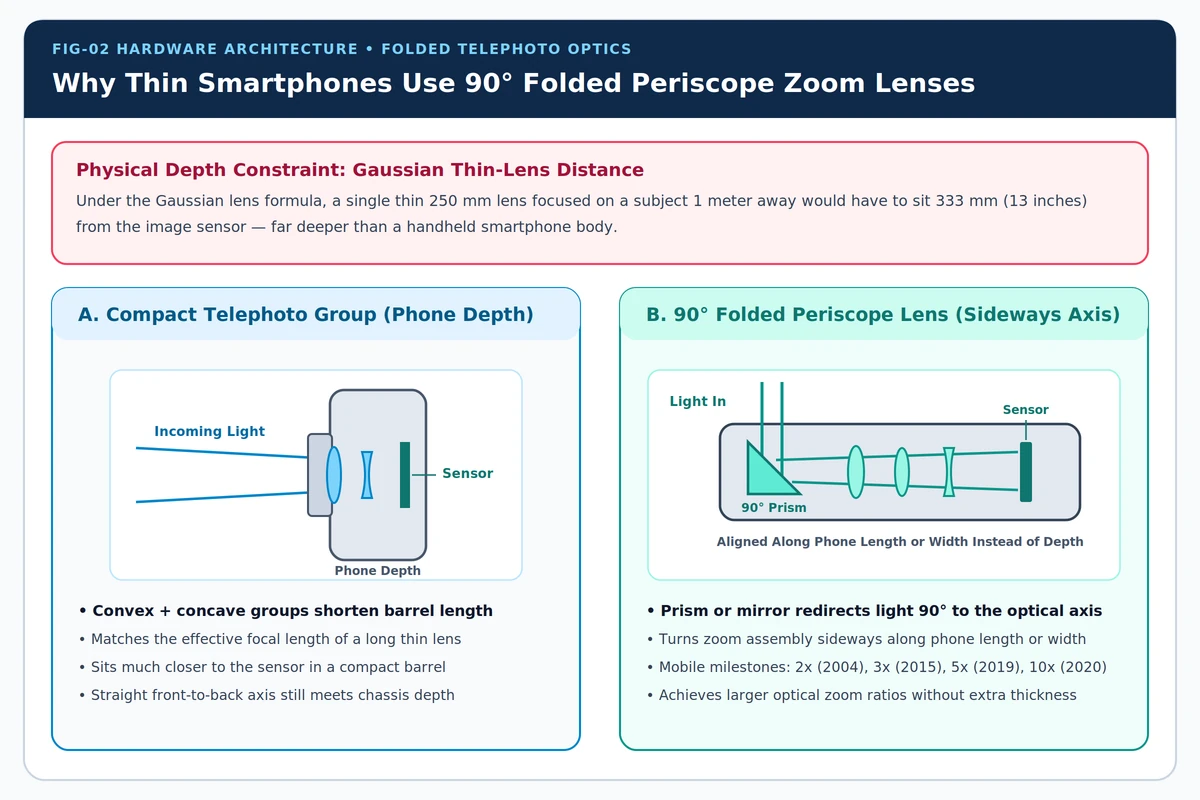
Long focal lengths require physical optical path length that cannot fit straight through a slim handset. As Marc Levoy’s Stanford University lecture notes on telephoto zoom lenses demonstrate under the Gaussian lens formula, a single thin 250 mm lens focused on a subject 1 meter away would have to sit 333 mm (13 inches) from the sensor. A true telephoto lens shortens that barrel by combining a front convex lens group with a rear concave lens group, achieving the same effective focal length much closer to the sensor.
To push optical magnification higher without thickening the phone body, smartphones adopt folded optics. As detailed in Wikipedia’s entry on periscope lenses, a periscope lens uses a prism or mirror to redirect incoming light at a 90° angle to the optical axis, orienting the lens assembly along the length or width of the smartphone rather than its depth. Mobile periscope designs progressed from a 2x variable zoom phone camera in 2004 and a 3x dual-periscope smartphone lens in 2015 to 5x periscope zoom in 2019 and 10x periscope zoom in 2020.
How Phone Camera Sensor Size Shapes Reach and Noise
Changing sensor size alters the camera’s angular field of view alongside focal length. According to Wikipedia’s guide to image sensor formats, digital sensors smaller than the 24 mm × 36 mm full-frame 35 mm area capture a smaller region of the lens’s image circle, producing a narrower field of view for any given focal length; the format size ratio relative to 35 mm film is the crop factor or focal-length multiplier. Spec sheets also express phone camera sensor sizes in historical video-camera-tube fractional inches rather than actual silicon dimensions:
Scroll horizontally to view all table columns.
| Sensor Format Descriptor | Physical Reference or Actual Diagonal | Optical & Shot-Noise Consequence |
|---|---|---|
| 35 mm full-frame reference | 24 mm × 36 mm image area; 6 μm full-frame pixel benchmark | Baseline reference for 35 mm crop factor; roughly 5× better shot-noise SNR than a 1.1 μm phone pixel at f/1.5–2 |
| Interchangeable-lens 3.7 μm benchmark | Smaller than 24 mm × 36 mm full-frame; 3.7 μm pixel pitch | Roughly 3× better shot-noise SNR than a 1.1 μm cell phone sensor at comparable f/1.5–2 apertures |
| 1“ type digital sensor | About 16 mm actual sensor diagonal (video-tube equivalence) | Larger active area than smaller fractional-inch phone sensors; SNR scales with square root of sensor area |
| 1/2.7“ optical-format sensor | Closer to 0.26 in (6.6 mm) actual diagonal, not 0.37 in (9.4 mm) | Strong field-of-view crop factor for compact telephoto reach, paired with tighter photon-gathering area |
How Should Buyers Verify Smartphone Zoom Specs?
Buyers should separate fixed telephoto or 90° periscope zoom lenses along the phone body from 1.4× and 2.0× intelligent zoom modes that read only the centre of the image sensor at reduced resolution, while checking fractional-inch sensor diagonals and 2160p image sensor lossless digital zoom for video recording.
Run this five-point verification checklist against any Android phone’s specification sheet before buying:
- Count dedicated rear telephoto modules separately from main-sensor crops: Confirm whether a listed 3×, 5×, or 10× periscope zoom lens is a separate fixed telephoto rear camera rather than 1.4× and 2.0× intelligent zoom options reading only the centre of the image sensor without interpolating.
- Distinguish optical zoom steps from maximum hybrid or digital numbers: Remember that multi-camera phones only deliver full-sensor optical projection at each fixed camera’s native focal length and rely on hybrid digital cropping and AI processing between and beyond those steps. To see how 3× and 5× dedicated telephotos split compact flagships in practice, check our compact Android flagship camera comparison.
- Translate fractional-inch sensor sizes into real silicon diagonals: Treat optical-format labels such as 1“ (about 16 mm diagonal) and 1/2.7“ (about 6.6 mm / 0.26 in diagonal rather than 9.4 mm / 0.37 in) as video-tube equivalents, and compare pixel pitch alongside f-number because SNR scales linearly with pixel pitch at identical f-numbers.
- Check video recording resolution when using lossless video zoom: A 2160p sensor only achieves lossless sensor-crop zoom up to 2× at 1080p, 3× at 720p, and 4.5× at 480p when spare sensor pixels exceed the recorded video raster.
- Preserve raw or lossless files if you plan to crop later: Use in-camera zoom ahead of lossy compression when shooting compressed formats, or capture lossless files so post-production resizing matches or exceeds in-camera digital zoom.
Frequently Asked Questions
Does digital zoom increase a phone camera’s optical resolution?
No. Digital zoom narrows the angle of view electronically by cropping a smaller central area of the image at the same aspect ratio and scaling it back to the original dimensions without adjusting the camera optics, so zero optical resolution is gained.
Do smartphones with optical zoom have a moving zoom lens?
Most smartphones advertised with optical zoom do not use a single continuous variable-focal-length lens; instead, they combine separate fixed-focal-length rear cameras—such as 3× or 5× telephoto or 90-degree periscope modules—with digital cropping and software processing in a hybrid system.
Is a 2x sensor crop the same as upscaled digital zoom?
Not when saved without interpolation: intelligent zoom modes at 1.4× and 2.0×, along with 2160p image sensor cropping for 1080p video recording, read only the centre of the image sensor without interpolating or upscaling back to full resolution, preserving image quality at reduced resolution across a smaller active sensor area.
Why do flagship phones use 90-degree periscope telephoto lenses?
Under the Gaussian lens formula, a single thin 250 mm lens focused at 1 meter would sit 333 mm (13 inches) from the sensor; folding light 90 degrees with a prism or mirror lets smartphones align long-focus zoom optics along the phone’s length or width without adding thickness.
Does a 1-inch or 1/2.7-inch phone camera sensor measure that size across?
No. Fractional-inch sensor descriptors reflect historical video camera tube equivalence rather than actual silicon dimensions: a 1“ type digital sensor measures about 16 mm on the diagonal, and a 1/2.7“ sensor measures closer to 0.26 in (6.6 mm) rather than 0.37 in (9.4 mm).
Sources
- Wikipedia — Digital zoom — Electronic centre-area cropping and pixel scaling, lossy vs lossless compression behavior, budget vs fixed-telephoto camera phones, 1.4× and 2.0× intelligent sensor crops, 2160p video crop multipliers, and smartphone hybrid zoom past 3× or 5× lenses.
- Wikipedia — Zoom lens — Variable-focal-length optical zoom vs fixed prime lenses, parfocal vs nearly parfocal consumer designs, 100–400 mm (4:1 / 4×) zoom ratio definition, multi-camera smartphone hybrid systems, optical compromises, and close-focus focal-length reduction.
- Wikipedia — Periscope lens — 90-degree prism or mirror folded light path, sideways alignment along smartphone length or width to preserve thin depth, and 2004 (2x), 2015 (3x), 2019 (5x), and 2020 (10x) mobile periscope milestones.
- Wikipedia — Image sensor format — 24 mm × 36 mm full-frame 35 mm crop factor, active sensor area modes, square-root sensor-area and pixel-pitch shot-noise SNR scaling, 1.1 μm vs 3.7 μm and 6 μm SNR comparison at f/1.5–2, and 1“ (16 mm) vs 1/2.7“ (6.6 mm) actual sensor diagonals.
- Stanford University (Marc Levoy) — Telephoto zoom lenses — Gaussian thin-lens 250 mm at 1 m (333 mm / 13 in) sensor distance, compact convex-concave telephoto lens groups, and focal-length plus sensor-size control over angular field of view.
TasteOfAndroid is responsible for this page. The byline, method and commercial relationships are on the editorial policy and the author page.
Related Articles
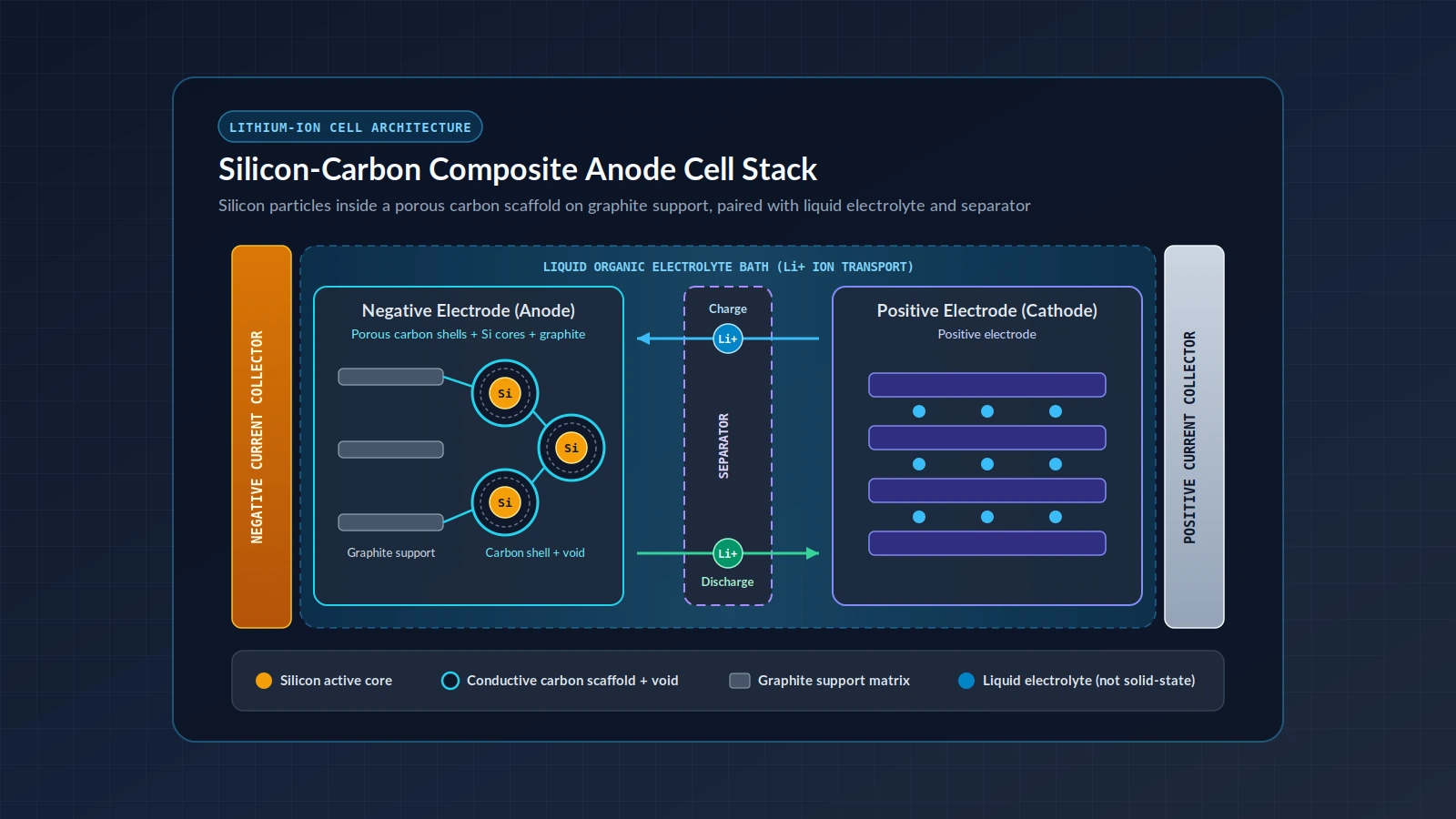
Silicon-Carbon Battery Explained: Anode Design, Expansion, Cycle Limits, and Solid-State Differences
A silicon-carbon battery is a liquid-electrolyte lithium-ion cell that pairs silicon with carbon or graphite in the anode, not a solid-state battery.
Hearing-Aid Compatibility (HAC), ASHA, and Bluetooth LE Audio on Android
Certain Pixel phones stream media and calls directly to hearing aids over Android Audio Streaming for Hearing Aids (ASHA) or the Bluetooth SIG Hearing Access Profile (HAP).
Wi-Fi 6E Versus Wi-Fi 7 on Android: 6 GHz Band and Channel Width Checks
Introduced in 2024, Wi-Fi 7 enhances performance across the 2.4 GHz, 5 GHz, and 6 GHz bands, delivering high throughput, lower latency, and greater reliability.