
Contents
- How Does mmWave 5G Compare With Sub-6 GHz 5G?
- Why Wider Channels Unlock Multi-Gigabit Speeds
- Why Millimeter Wavelengths Lose Signal Indoors
- How Does 5G mmWave Differ From C-Band 5G?
- Which U.S. Carriers Have mmWave 5G, and What Is 5G UW vs. 5G UC vs. 5G+?
- Where Is mmWave 5G Available, and Why Do Connections Hand Off Frequently?
- Is mmWave 5G Worth Paying Extra for on an Android Phone?
- How Many 5G Bands Should an Android Phone Support?
- Frequently Asked Questions
- What is the difference between mmWave 5G and Sub-6 GHz 5G?
- Does seeing 5G UW, 5G UC, or 5G+ mean my phone is connected to mmWave?
- Why does mmWave 5G stop working when I walk inside a building?
- Is C-Band 5G the same as mmWave 5G?
- Do I need an mmWave-capable Android phone if I use T-Mobile or AT&T?
- Sources
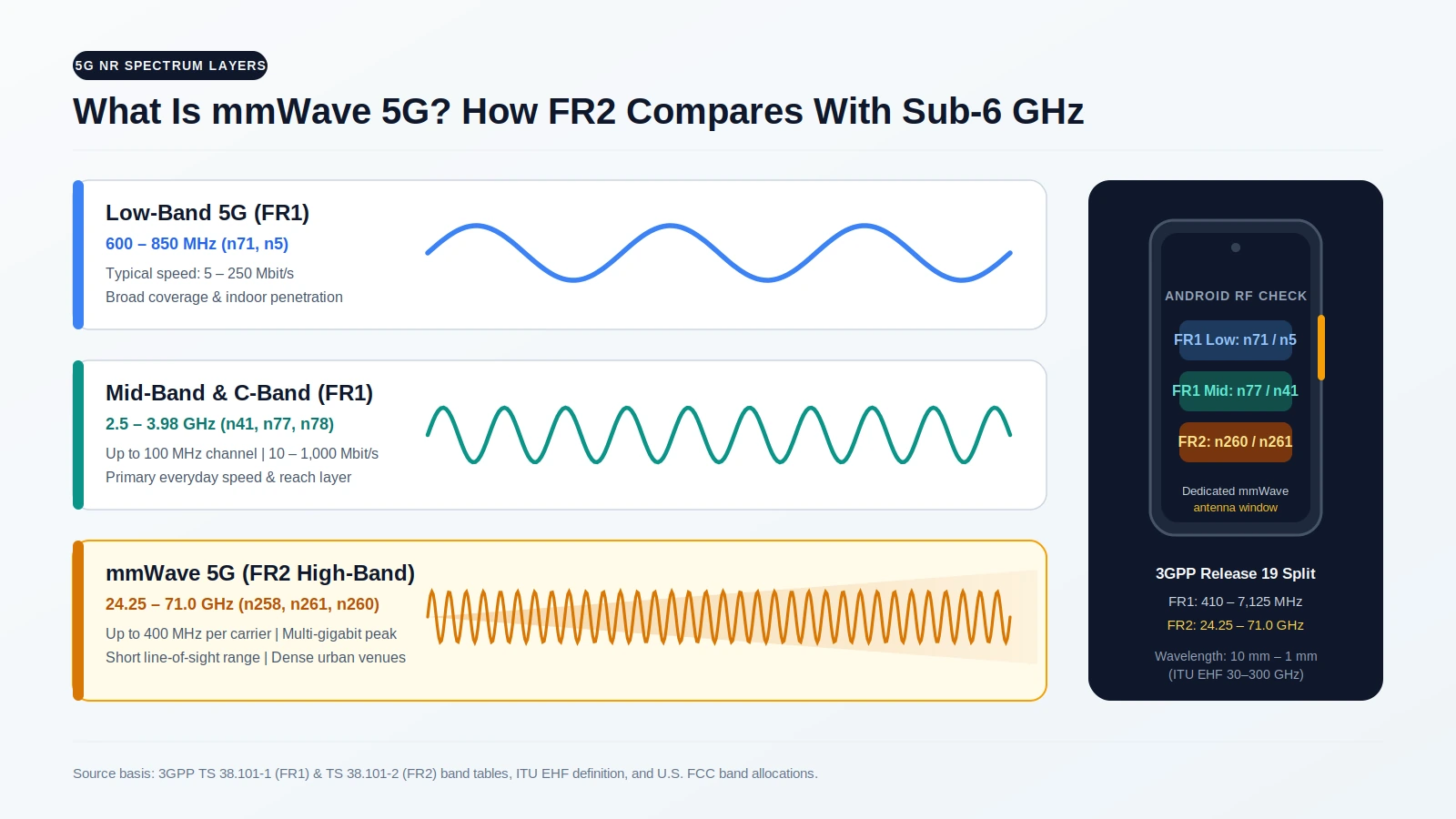
mmWave 5G is high-band cellular service in 3GPP Frequency Range 2 (FR2) between 24.25 GHz and 71.0 GHz, using wide 400 MHz channels for multi-gigabit speeds in dense venues while trading away range and wall penetration. Because signals can lose over 100 dB through building materials, most Android buyers need strong Sub-6 mid-band support first.
The International Telecommunication Union (ITU) formally designates Extremely High Frequency (EHF) as 30 to 300 GHz, where radio waves have wavelengths of 10–1 mm. Cellular engineers extend the millimeter-wave label down to 24 GHz so all 5G New Radio (NR) FR2 bands from 24.25 GHz to 71.0 GHz fit under the mmWave umbrella. Comparing cellular frequency hardware belongs alongside our broader Android phone buying guides.
How Does mmWave 5G Compare With Sub-6 GHz 5G?
Sub-6 GHz 5G (3GPP FR1, spanning 410 MHz to 7,125 MHz) prioritizes broad coverage and indoor reception with channels up to 100 MHz, whereas mmWave 5G (FR2, 24.25 to 71.0 GHz) supports up to 400 MHz per carrier for multi-gigabit capacity over short line-of-sight links. Everyday cellular performance depends on which tier your phone and local tower actually share.
Under 3GPP TS 38.101-1 (Range 1) and TS 38.101-2 (Range 2), 5G NR bands use the prefix n and retain the same band number whenever they overlap with a 4G LTE band. In practice, operators deploy 5G across three tiers: low-band FR1 for wide geographic reach, mid-band FR1 for everyday urban and suburban throughput, and high-band FR2 mmWave for localized crowd capacity.
Scroll horizontally to view all table columns.
| 5G Spectrum Tier | 3GPP Range & Key Bands | Frequency Span | Max Channel Width (Per Carrier) | Typical Real-World Speed Range | Coverage & Penetration Profile |
|---|---|---|---|---|---|
| Low-Band Sub-6 | FR1: n71, n5 | 600–850 MHz | 25–35 MHz (FDD) | 5–250 Mbit/s | Wide macro reach (hundreds of square miles at 600 MHz) and strong indoor penetration |
| Mid-Band & C-Band Sub-6 | FR1: n41, n77, n78 | 2.5–4.2 GHz | Up to 100 MHz (TDD) | 10–1,000 Mbit/s | Balanced urban and suburban macro coverage with reliable indoor reception |
| High-Band mmWave | FR2: n258, n261, n260, n257 | 24.25–71.0 GHz | Up to 400 MHz (TDD; up to 2,000 MHz on n263) | Multi-gigabit (up to 5.9 Gbit/s measured deployed peak) | Short small-cell reach (100–500 m), line-of-sight dependent, blocked by walls and foliage |
Why Wider Channels Unlock Multi-Gigabit Speeds
Radio channel bandwidth acts like the number of highway lanes carrying data at once. While FR1 caps each standalone carrier at 100 MHz with typical download speeds from 5 to 900 Mbit/s depending on conditions, FR2 defines licensed TDD channel widths of 50, 100, 200, and 400 MHz across n257 (26.50–29.50 GHz), n258 (24.25–27.50 GHz), n260 (37.00–40.00 GHz), n261 (27.50–28.35 GHz), and n262 (47.20–48.20 GHz), plus unlicensed n263 (57.00–71.00 GHz) scaling up to 2,000 MHz. Peer-reviewed 5G heterogeneous network research notes that 28 GHz deployments can harness up to 850 MHz of total bandwidth alongside directional beamforming gains.
Even with wide spectrum, laboratory peaks differ sharply from daily averages. Although the IMT-2020 framework defines a theoretical peak download rate of 20 Gbit/s and the highest deployed 5G speed measured in 2023 reached 5.9 Gbit/s, measured average 5G download speeds in the United States sat near 186 Mbit/s on T-Mobile, compared with roughly 430 Mbit/s in South Korea in 2022.
Why Millimeter Wavelengths Lose Signal Indoors
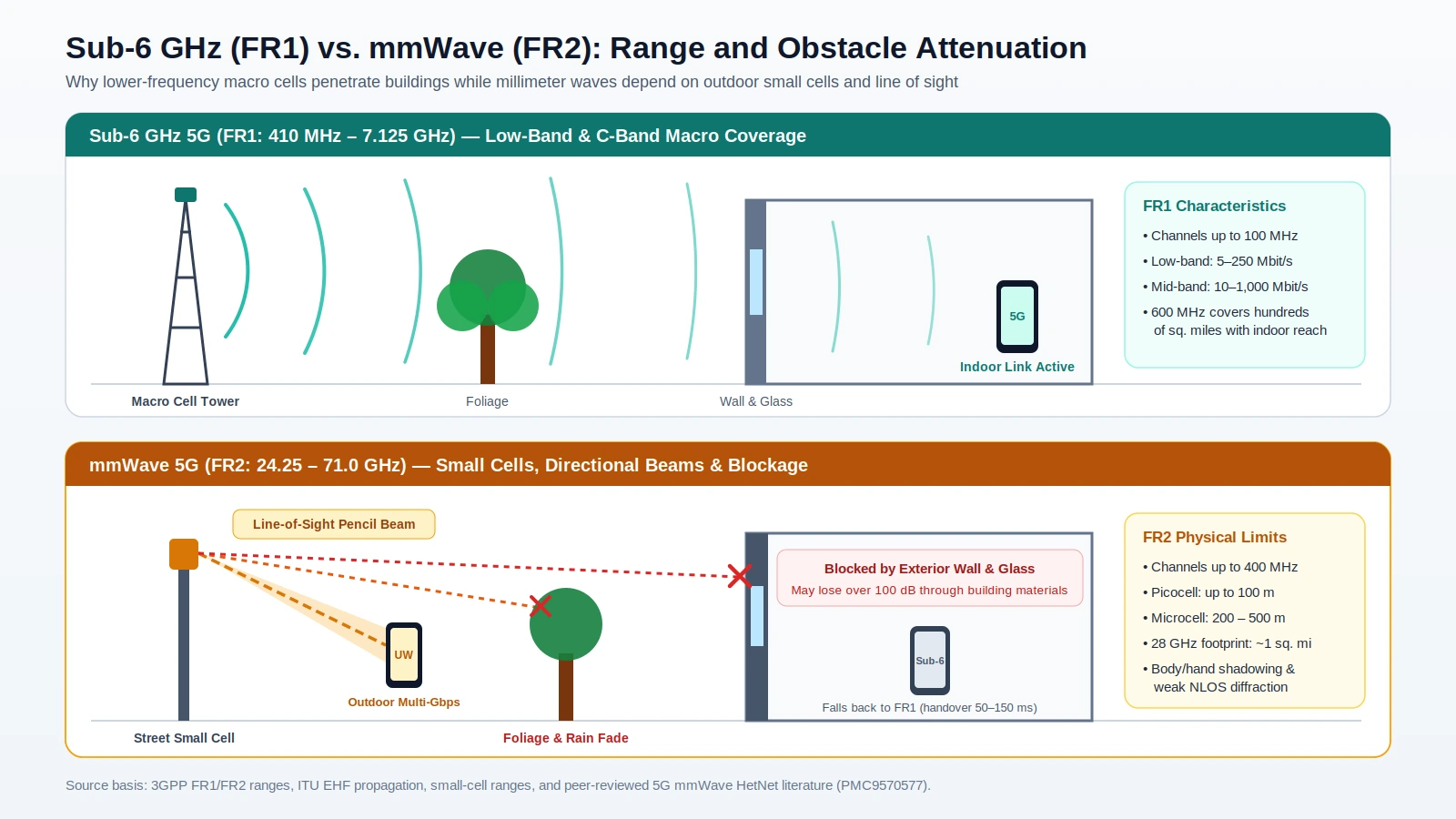
Short wavelengths obey strict propagation physics. Millimeter waves travel solely along line-of-sight paths rather than bending around corners or refracting like lower-frequency radio waves. Because their diffraction is very weak, non-line-of-sight (NLOS) received power drops sharply behind obstacles.
At typical power densities, building walls block millimeter waves and common building materials can cause more than 100 dB of signal loss. Peer-reviewed millimeter-wave studies document severe penetration loss from concrete walls, glass, bricks, furniture, foliage, and even the human body holding a portable device. Weather and atmospheric gases add further limits: absorption peaks around water vapor at 24 GHz and 184 GHz and oxygen at 60 GHz, and because millimeter wavelengths match the size of raindrops, precipitation causes scattering and absorption known as rain fade.
How Does 5G mmWave Differ From C-Band 5G?
C-Band 5G operates in mid-band FR1 (3.7 to 3.98 GHz in U.S. FCC allocations on band n77), delivering reliable macro-tower coverage and indoor reception with up to 100 MHz channels, whereas mmWave operates above 24.25 GHz in FR2 and depends on dense outdoor small cells. C-Band is therefore the everyday workhorse layer, while mmWave serves localized high-density hotspots.
Terminology around C-Band occasionally confuses shoppers because two standards bodies use slightly different boundaries. The Institute of Electrical and Electronics Engineers (IEEE) designates C-band as 4.0 to 8.0 GHz, whereas the U.S. Federal Communications Commission (FCC) C-band proceeding in February 2020 designated 3.7 to 4.2 GHz. Under those FCC rules, the lower 280 MHz (3.7 to 3.98 GHz) was allocated for terrestrial 5G wireless use, a 20 MHz guard band sits from 3.98 to 4.0 GHz, and incumbent satellite operators repacked into the upper 200 MHz from 4.0 to 4.2 GHz.
Mid-band C-Band continues expanding in the United States. Under Pub. L. No. 119-21, enacted on July 4, 2025, Congress mandated a second FCC auction of upper C-band spectrum between 3.98 and 4.2 GHz to allocate at least 100 MHz (with up to 180 MHz proposed) by July 4, 2027. For Android buyers, band n77 (3,300 to 4,200 MHz) covers U.S. C-band deployments, while its subset n78 (3,300 to 3,800 MHz) covers narrower C-band allocations; both operate in TDD mode with channel widths from 10 to 100 MHz.
Which U.S. Carriers Have mmWave 5G, and What Is 5G UW vs. 5G UC vs. 5G+?
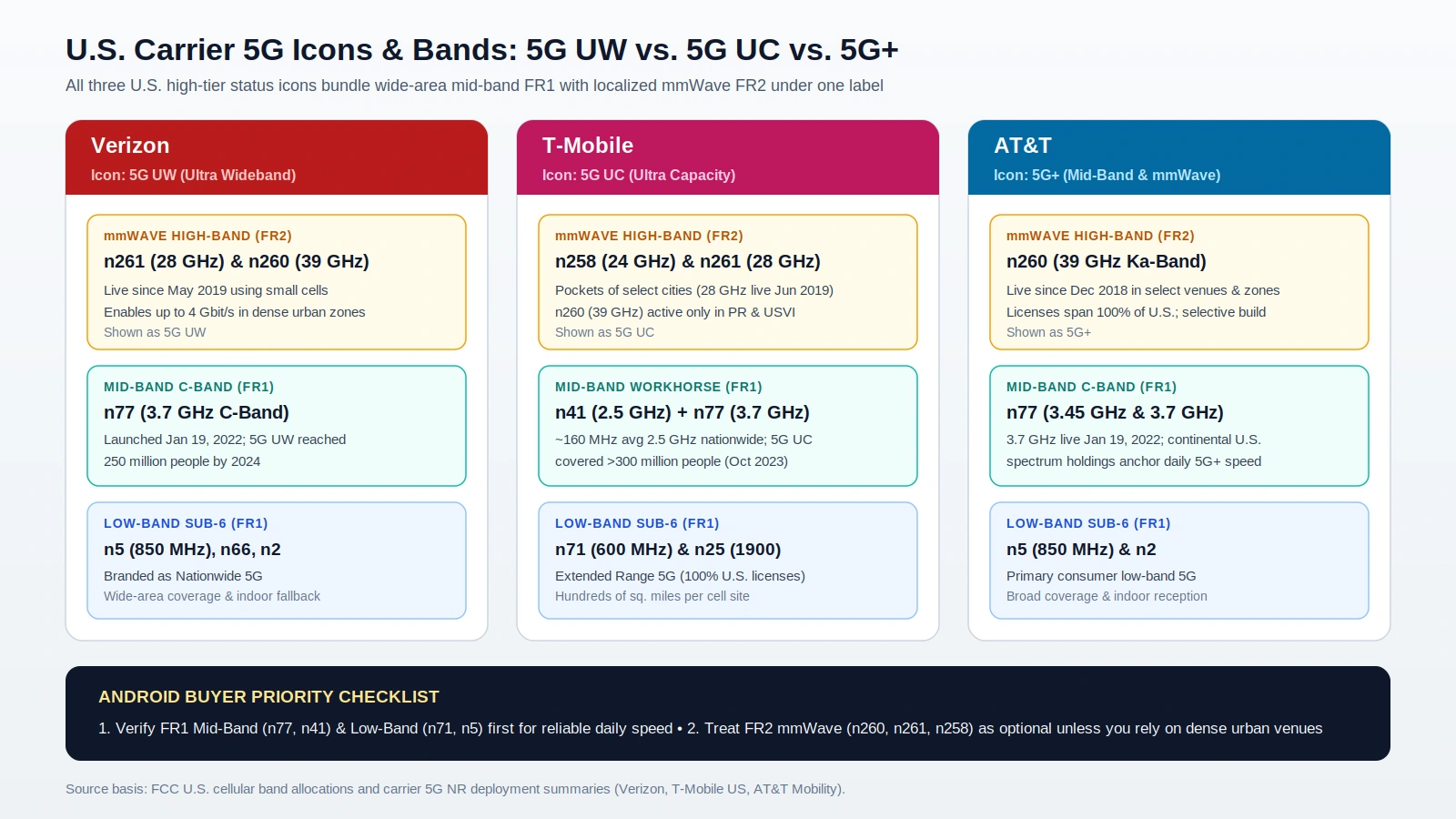
Verizon, T-Mobile, and AT&T all operate mmWave 5G in select areas, and all three bundle mid-band FR1 and mmWave FR2 under one status-bar icon: Verizon 5G Ultra Wideband (5G UW), T-Mobile Ultra Capacity 5G (5G UC), and AT&T 5G+. Seeing those icons can reflect mid-band FR1 rather than mmWave, because both layers share the same badge.
Each national U.S. carrier combines low-band, mid-band, and high-band spectrum differently based on its FCC licenses:
Scroll horizontally to view all table columns.
| U.S. Carrier | High-Tier Status Icon | Low-Band FR1 Layer | Primary Mid-Band FR1 Layer | mmWave FR2 Layer & Deployment Notes |
|---|---|---|---|---|
| Verizon | 5G UW (Ultra Wideband) | Nationwide 5G (sub-6 GHz, including n5) | n77 (3.7 GHz C-Band, live January 19, 2022) | n261 (28 GHz, live May 2019, enabling 4 Gbit/s with small cells) and n260 (39 GHz); 5G UW reached 250 million people by 2024 |
| T-Mobile | 5G UC (Ultra Capacity) | n71 (600 MHz Extended Range 5G, live December 2, 2019, 100% U.S. licenses) | n41 (2.5 GHz BRS, ~160 MHz nationwide avg, 100 MHz target) plus n77 (3.7 GHz) | n258 (24 GHz) in pockets of select cities and n261 (28 GHz, live June 2019) in select areas; n260 (39 GHz) active only in Puerto Rico and USVI after AT&T swap; 5G UC exceeded 300 million people by October 2023 |
| AT&T | 5G+ | n5 (850 MHz primary low-band 5G) | n77 (3.45 GHz acquired 2021 and 3.7 GHz live January 19, 2022, 100% continental U.S. licenses) | n260 (39 GHz, live December 2018) in select high-traffic areas despite 100% U.S. spectrum licenses |
The key takeaway when comparing 5G UW vs. 5G UC is that the underlying mid-band frequency explains most day-to-day performance differences. Verizon and AT&T anchor their high-tier coverage on C-band n77 (3.7 GHz, plus 3.45 GHz on AT&T), while T-Mobile anchors Ultra Capacity 5G on 2.5 GHz band n41 acquired through its 2020 Sprint merger alongside n71 at 600 MHz for wide-area fallback. T-Mobile also swapped its Lower 48, Hawaii, and Alaska 39 GHz (n260) spectrum with AT&T for additional 24 GHz (n258), which is why T-Mobile buyers outside Puerto Rico and the U.S. Virgin Islands rely on n258 and n261 for mmWave rather than n260.
Where Is mmWave 5G Available, and Why Do Connections Hand Off Frequently?
mmWave 5G is deployed mainly in outdoor urban corridors, stadiums, airports, and crowded public venues via low-power small cells covering a few dozen to a few hundred meters, so walking indoors or around a building corner frequently triggers a handover back to Sub-6 5G. Those transitions briefly raise latency even when peak outdoor throughput is high.
Cell geometry explains why carriers cannot blanket entire metro areas with mmWave towers alone. In T-Mobile’s band comparison, a 28 GHz cell reaches roughly 1 square mile (2.6 km) under favorable conditions, whereas 600 MHz low-band spectrum can cover hundreds of square miles from a single site. To keep high-band links usable in cities and venues, operators rely on dense small cells: picocells serving roughly 64 to 128 users at 0.1 to 5 W over up to 100 m, and microcells serving roughly 128 to 256 users at 5 to 10 W over 200 to 500 m, supplemented by beamforming antennas and repeaters.
Frequent cell-edge transitions also affect responsiveness. Typical 5G air latency sits around 8 to 12 ms excluding retransmissions and handovers, and edge servers near base stations can keep round-trip time near 14 ms with about 1.8 ms jitter. During handovers between cells or frequency layers, however, latency climbs to 50 to 150 ms depending on network conditions—a noticeable pause when a pedestrian steps past a concrete pillar or shifts their grip across a phone’s edge antenna window.
Is mmWave 5G Worth Paying Extra for on an Android Phone?
For most Android buyers, mmWave 5G is not worth paying extra for unless you regularly use Verizon in dense downtown zones, stadiums, or airports where small cells are active. Hardware constraints explain why many mid-range and international Android phones omit FR2 antennas while preserving full Sub-6 mid-band support.
Supporting 28 GHz and 39 GHz inside a slim smartphone chassis creates real engineering trade-offs documented in peer-reviewed antenna literature:
- Specialized RF components and transceivers: High-performance millimeter-wave RF parts are expensive and raise handset bill-of-materials cost significantly, while microwave transceiver analog-to-digital converters (ADCs) must be redesigned to support directional pencil-beam transmission.
- Tight chassis packaging and thermal limits: Conventional miniaturization methods—such as array stacking, complex feeding networks, and exotic substrates—trade internal phone volume for higher cost, lower manufacturing yields, or added thermal stress, even as newer research prototypes have demonstrated dual-band 28 GHz (n257/n258) and 38 GHz (n260) smartphone antennas down to 12 × 8 × 0.64 mm³.
- Regional SKU omissions: Because mmWave rollouts remain concentrated in select dense U.S. locations rather than nationwide rural or suburban corridors, international and imported Android variants frequently skip n260, n261, and n258 while supporting global FR1 bands. If you are considering an imported model, verify carrier certification, Play Protect status, and warranty boundaries in our Global Version vs. China Version phone buying guide.
- Indoor multi-gigabit alternative: Because mmWave struggles to enter homes and offices, high-throughput indoor transfers rely far more on local wireless routers than on cellular FR2; check local router spectrum and channel widths in our Android wireless band and channel width guide.
Choose an Android model with FR2 (n260 and n261, plus n258 for T-Mobile pockets) if you spend substantial time on Verizon in major sports arenas, transit hubs, or dense outdoor business districts and want multi-gigabit crowd capacity. Otherwise, prioritize full FR1 mid-band and low-band coverage for your carrier over an mmWave badge.
How Many 5G Bands Should an Android Phone Support?
Total 5G band count matters far less than matching the exact FR1 low-band and mid-band frequencies your carrier actually deploys. A phone listing dozens of bands that misses your carrier’s primary mid-band channel (n77 on Verizon or AT&T, or n41 on T-Mobile) will feel noticeably slower than a phone with fewer total bands that covers your exact local spectrum.
Before buying an unlocked or carrier Android smartphone, check the exact regional SKU specification sheet against this band verification table:
Scroll horizontally to view all table columns.
| 3GPP 5G NR Band | Frequency Range & Duplex Mode | Channel Bandwidths | Primary Network Role | Android Buyer Priority |
|---|---|---|---|---|
| n77 | 3,300–4,200 MHz (TDD, C-Band) | 10–100 MHz | Verizon 5G UW, AT&T 5G+ (3.45 & 3.7 GHz), T-Mobile urban supplement | Essential for U.S. Verizon and AT&T buyers; valuable across all U.S. networks |
| n78 | 3,300–3,800 MHz (TDD, C-Band subset of n77) | 10–100 MHz | Primary mid-band 5G across Europe and Asia | Essential for international travel outside North America |
| n41 | 2,496–2,690 MHz (TDD, 2.5 GHz BRS) | 5–100 MHz | T-Mobile primary Ultra Capacity 5G mid-band | Essential for T-Mobile U.S. buyers |
| n71 | 617–652 MHz DL / 663–698 MHz UL (FDD, 600 MHz) | 5–35 MHz | T-Mobile primary Extended Range low-band 5G | Essential for T-Mobile rural and indoor coverage |
| n5 | 869–894 MHz DL / 824–849 MHz UL (FDD, 850 MHz) | 3–25 MHz | AT&T primary low-band 5G and Verizon low-band sub-6 | Essential for AT&T and Verizon broad coverage |
| n66 & n25 | n66: 1,710–1,780 UL / 2,110–2,200 DL; n25: 1,850–1,915 UL / 1,930–1,995 DL (FDD) | 5–45 MHz | Wide-area U.S. mid-band FDD capacity across major carriers | High priority for consistent urban and highway aggregation |
| n260 & n261 | n260: 37.00–40.00 GHz; n261: 27.50–28.35 GHz (TDD, FR2) | 50–400 MHz | Verizon 5G UW mmWave (n260/n261), AT&T 5G+ mmWave (n260), T-Mobile select mmWave (n261) | Optional; prioritize mainly for heavy Verizon dense-venue users |
| n258 | 24.25–27.50 GHz (TDD, FR2) | 50–400 MHz | T-Mobile pockets of select U.S. cities and select global FR2 builds | Optional; secondary to FR1 mid-band support |
Confirming your carrier’s three core FR1 anchors—low-band (n71 or n5), mid-band TDD (n41 or n77), and FDD AWS/PCS (n66 and n25)—protects everyday speeds indoors and on highways far more reliably than chasing a high headline band count.
Frequently Asked Questions
What is the difference between mmWave 5G and Sub-6 GHz 5G?
Sub-6 GHz 5G (3GPP FR1, 410 MHz to 7,125 MHz) uses lower frequencies with up to 100 MHz channels to travel farther and penetrate walls reliably, delivering typical speeds of 5 to 250 Mbit/s on low-band and 10 to 1,000 Mbit/s on mid-band. mmWave 5G (FR2, 24.25 to 71.0 GHz) uses wider channels up to 400 MHz per carrier for multi-gigabit crowd capacity in stadiums and dense streets, but requires outdoor small cells and line-of-sight paths.
Does seeing 5G UW, 5G UC, or 5G+ mean my phone is connected to mmWave?
Not necessarily. Verizon 5G UW includes both 3.7 GHz C-band (n77) and mmWave (n260 and n261), T-Mobile 5G UC includes 2.5 GHz mid-band (n41) alongside pockets of 24 GHz (n258) and 28 GHz (n261), and AT&T 5G+ combines 3.45 GHz and 3.7 GHz C-band (n77) with select-area 39 GHz (n260). In most neighborhoods and indoors, those icons reflect mid-band FR1 rather than mmWave.
Why does mmWave 5G stop working when I walk inside a building?
Millimeter waves propagate strictly by line-of-sight paths with very weak diffraction, so exterior concrete walls, bricks, glass, foliage, and even human body shadowing cause steep attenuation. High-band signals can lose over 100 dB through common building materials, forcing your phone to hand over to Sub-6 5G or 4G LTE once you step indoors.
Is C-Band 5G the same as mmWave 5G?
No. U.S. C-band 5G operates in mid-band FR1 (3.7 to 3.98 GHz on band n77, plus AT&T’s 3.45 GHz allocation), using macro cell towers that reach indoors with channels up to 100 MHz. mmWave operates at 24.25 GHz and above in FR2, relying on short-range picocells (up to 100 m) and microcells (200 to 500 m) with up to 400 MHz channels.
Do I need an mmWave-capable Android phone if I use T-Mobile or AT&T?
Not for most everyday use. T-Mobile built its Ultra Capacity 5G footprint around 2.5 GHz mid-band (n41) and 600 MHz low-band (n71) with mmWave limited to select city pockets, while AT&T anchors nationwide 5G+ expansion on 3.45 GHz and 3.7 GHz C-band (n77) plus 850 MHz low-band (n5). Ensuring full FR1 mid-band and low-band support matters far more than paying extra for n260, n261, or n258 antennas.
Sources
- Federal Communications Commission (FCC 26-46, Federal Register): Upper C-Band (3.98–4.2 GHz) Report and Order — Adopted July 22, 2026, making 160 megahertz of Upper C-band spectrum available for terrestrial wireless flexible use within a unified 3.7–4.14 GHz service ahead of the July 4, 2027 competitive-bidding deadline.
- Federal Communications Commission (Federal Register): Expanding Flexible Use of the 3.7 to 4.2 GHz Band — Designates 280 megahertz of Lower C-band spectrum (3.7–3.98 GHz) for terrestrial wireless auction plus a 20 megahertz guard band (3.98–4.0 GHz).
- Federal Communications Commission (FCC 25-24, Federal Register): Lower 37 GHz Band and Use of Spectrum Bands Above 24 GHz — Adopted April 28, 2025, opening 600 megahertz of shared millimeter-wave spectrum (37–37.6 GHz) for fixed and mobile flexible use.
- Self-Optimizing Traffic Steering for 5G mmWave Heterogeneous Networks — Sensors (PMC9570577) — 28 GHz up to 850 MHz bandwidth, directional pencil-beam transmission, weak NLOS diffraction, concrete, furniture, human-body, and foliage penetration loss, and transceiver ADC complexity.
- Beam-Switching Antennas for 5G Millimeter-Wave Wireless Terminals — Sensors (PMC10383819) — Glass and brick penetration loss at 28 GHz and high cost of high-performance mmWave RF components in wireless terminals.
- Multi-phantom SAR-assessed ultra-compact dual-band mmWave antenna for 5G smartphones — PLoS One (PMC13229378) — Miniaturization trade-offs (volume vs. cost, yields, and thermal stress) and 12 × 8 × 0.64 mm³ dual-band 28 GHz (n257/n258) / 38 GHz (n260) smartphone antenna prototype.
- Advances in MIMO Antenna Design for 5G: A Comprehensive Review — Sensors (PMC10384345) — Susceptibility of mmWave links to rain and fog attenuation and reliance on directional beamforming across 5G frequency bands.
- 5G Numerologies Assessment for URLLC in Industrial Communications — Sensors (PMC8038383) — 3GPP New Radio millimeter-wave TDD MAC layer operation and beamforming protocol support.
TasteOfAndroid is responsible for this page. The byline, method and commercial relationships are on the editorial policy and the author page.
Related Articles
What Is PWM Dimming: OLED Flicker & DC Dimming
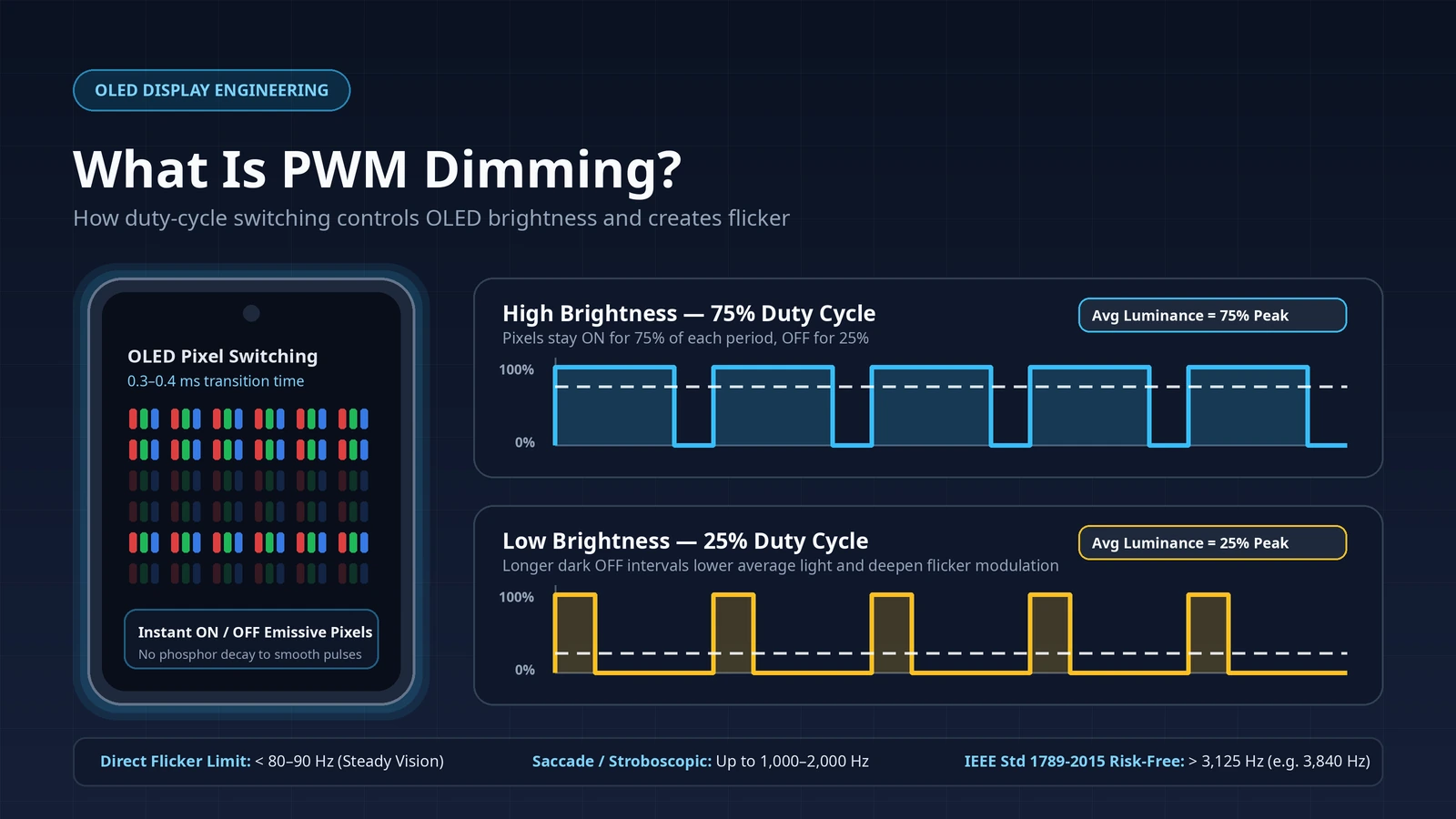
PWM dimming lowers smartphone OLED brightness by rapidly switching pixel power off and on, varying duty cycle—causing flicker at low frequencies vs DC dimming.
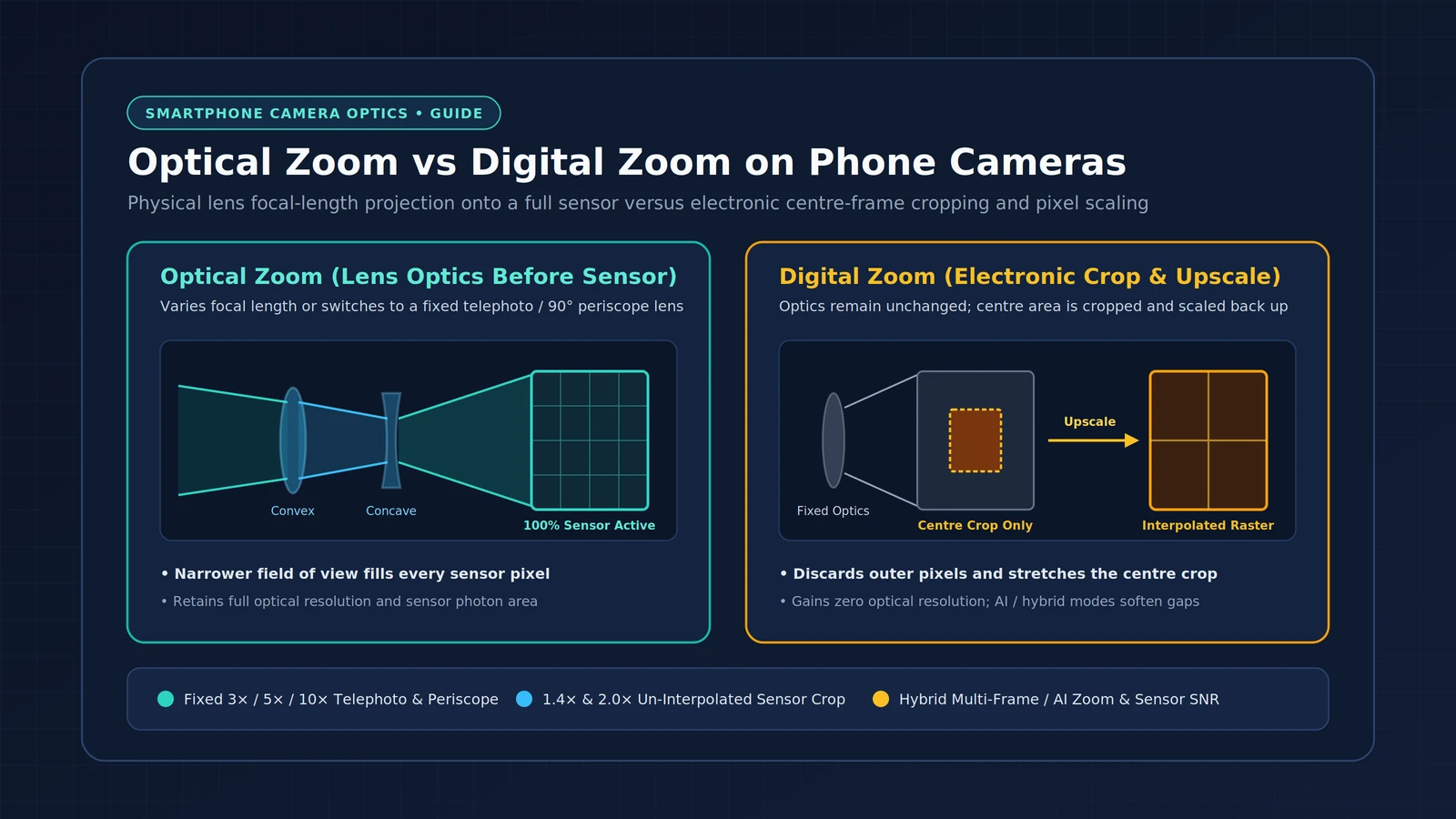
Optical Zoom vs Digital Zoom: Phone Camera Differences
Optical zoom changes physical focal length across a phone's full camera sensor, while digital zoom crops and scales the centre of the captured frame.
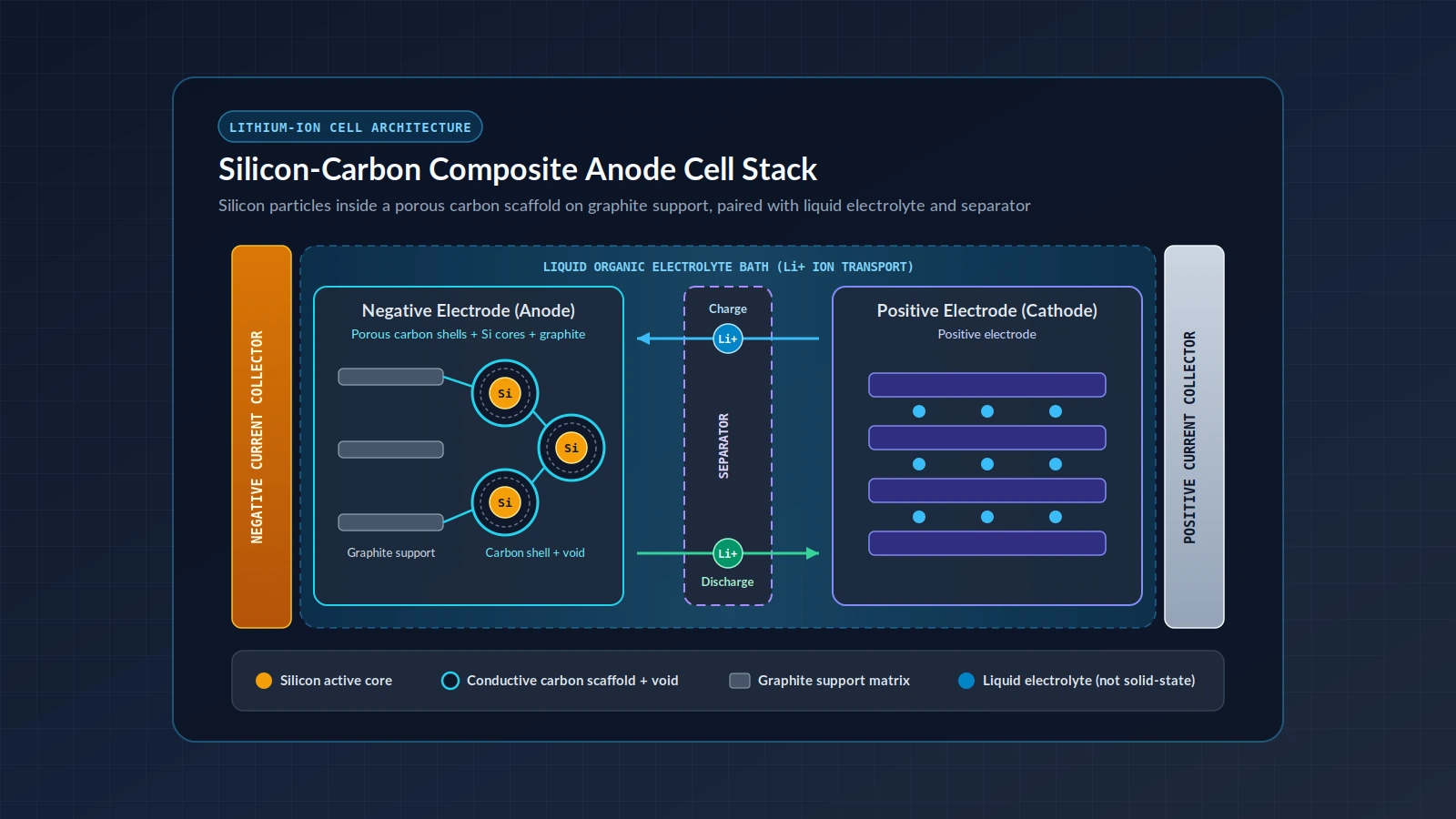
Silicon-Carbon Battery Explained: Anode Design, Expansion, Cycle Limits, and Solid-State Differences
A silicon-carbon battery is a liquid-electrolyte lithium-ion cell that pairs silicon with carbon or graphite in the anode, not a solid-state battery.