
Contents
- 1. Write the SKU before you compare offers
- 2. Pick the channel that can document that SKU
- 3. Match the Chinese legal entity to the publicity record
- 4. Make every offer answer the same line
- 5. Keep a reference unit, then inspect the batch
- 6. Match the destination file to the same model
- 7. Write the payment so it waits for a named record
- 8. Classify the battery before you book the route
- 9. Compute the cost per sellable unit, and leave the missing inputs blank
- When this file is the wrong file
- Pause the order on these mismatches
- What was saved
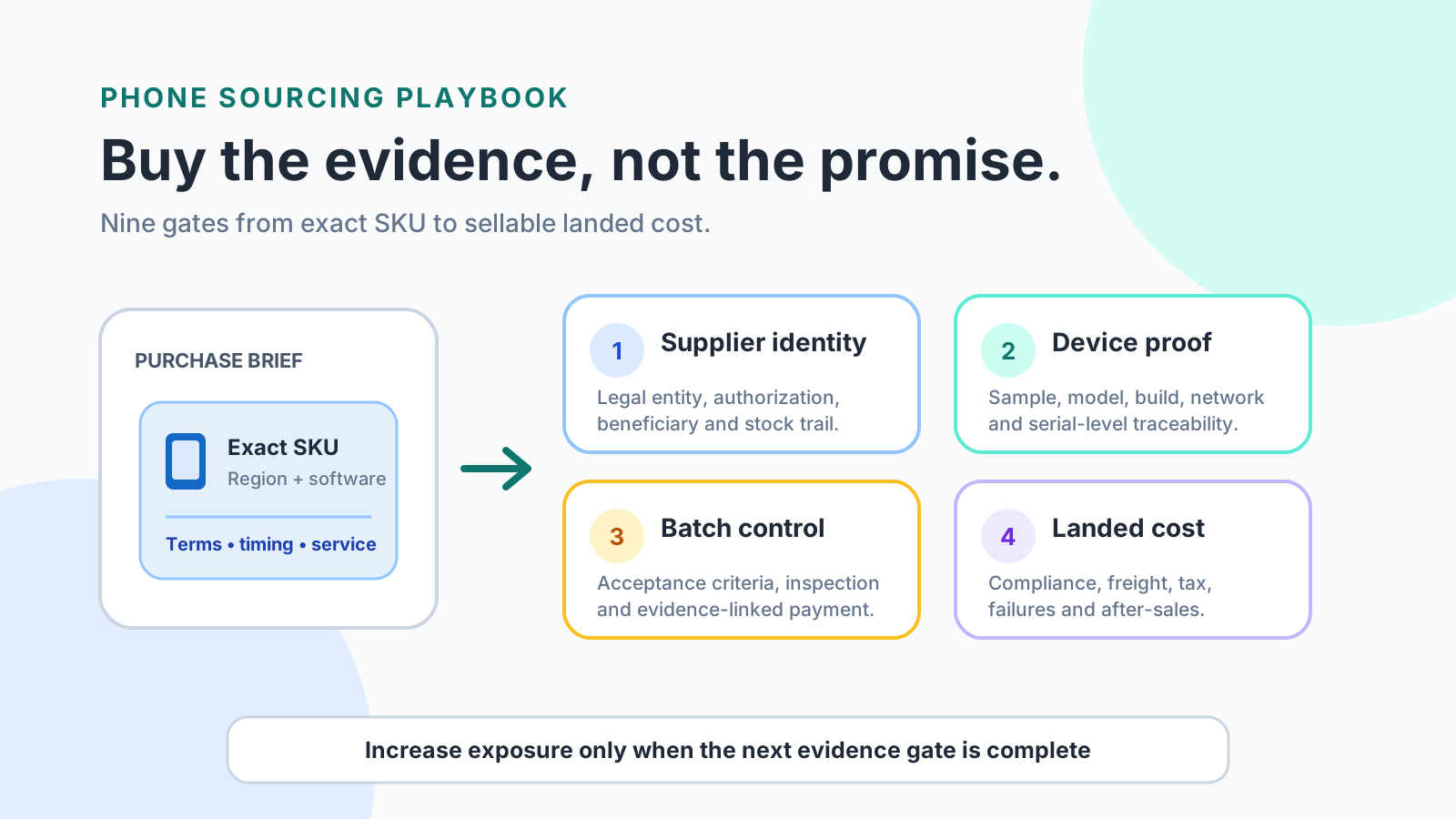
A wholesale order of mobile phones from China wastes the deposit and the freight when those phones cannot be sold at the destination. Lock the SKU, the Chinese legal entity, the destination authorization, the battery test summary, and the batch result before each payment.
Wholesale mobile phones from China only after the SKU, the supplier’s Chinese legal name, the destination radio authorization, and the lithium-battery test summary name the same goods. The market-supervision regulation saved on 18 October 2026 requires registration and filing information on the National Enterprise Credit Information Publicity System, and Article 6 requires that department to publicize registration and filing information within 20 working days after the record arises. A phone that intentionally emits or receives radio waves for communication is radio equipment under Directive 2014/53/EU. Importing a phone into the United States for sale is marketing under 47 CFR 2.803. HTS Revision 21 (2026) prints 8517.13.00.00, smartphones, with Column 1 General Free, and the search response sets additional duties to null. Unit price, minimum order, and lead time stay blank. None of the saved pages print them.
Scroll horizontally to read the labels in this diagram.
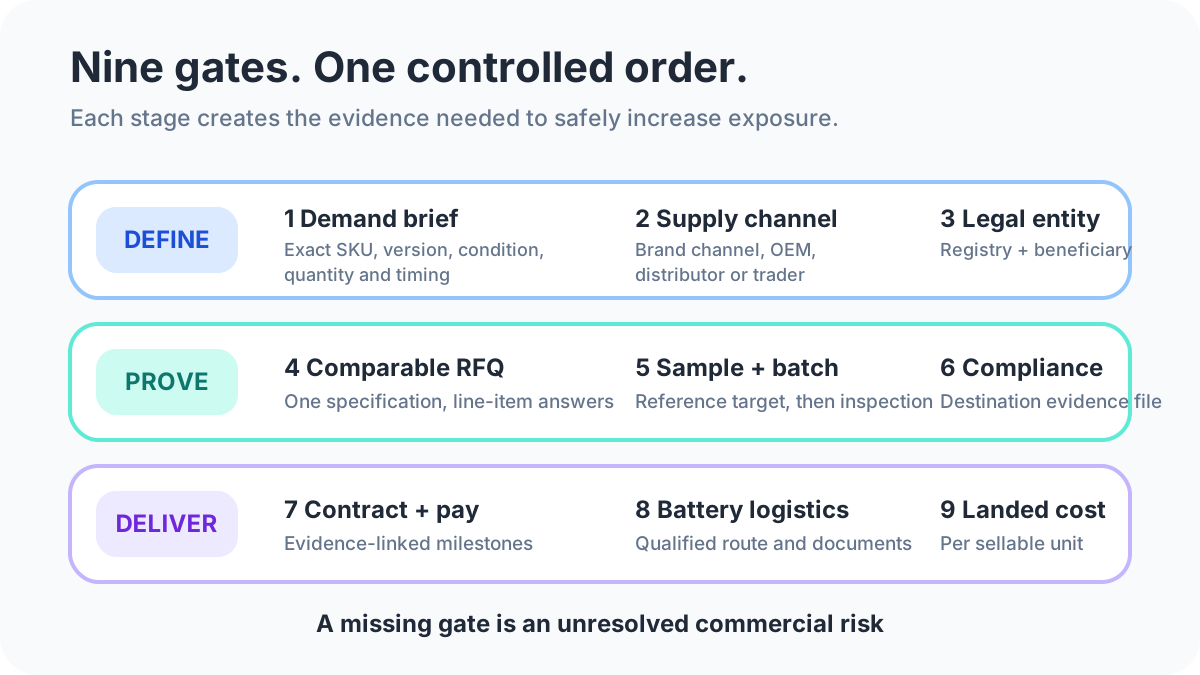
Open the full-size diagram of the nine evidence gates.
The diagram is the order of work. The table under it is the published figure that belongs in each gate. A blank cell means the saved page does not print that figure.
Scroll horizontally to view all table columns.
| Input or item | Published value on the saved page | Why it matters |
|---|---|---|
| Registration publicity | Within 20 working days after the record arises | A business-license photo is not the publicity record |
| Annual report window | 1 January to 30 June, for the prior year | After 30 June, check whether that report is on the system |
| US marketing | Includes importation, shipment, or distribution for sale or lease | A quote is not an equipment authorization |
| US test import | 4,000 or fewer units, and the devices will not be offered for sale or marketed | A resale lot does not fit that condition |
| EU importer file | CE marking, technical documentation, declaration of conformity kept 10 years | A CE logo without the file is an open importer duty |
| Play Protect | Licensed Google apps, and Android compatibility testing on record | The check is Play Store, profile, Settings, About |
| HTS smartphones | 8517.13.00.00, Column 1 General Free, Special blank, Column 2 35%, additional duties null | Free is one column |
| Battery inside the phone | UN 3481, PI 967. A charge at or under 30% is recommended and is not mandatory | Do not copy the loose-battery rule onto the handset |
| Battery packed with the phone | UN 3481, PI 966. From 1 January 2026 the charge cap is 30% when that section’s watt-hour condition is met | A spare pack in the carton is a different entry |
This page sits in the International Sourcing guides. When a listing says Global Version or China Version, use the checks that separate that label from carrier acceptance, Play Protect certification, and warranty.
1. Write the SKU before you compare offers
One line per phone, filled before any supplier sees the order. Two offers are comparable only when both lines name the same goods.
Scroll horizontally to view all table columns.
| Field | What to write | Published figure |
|---|---|---|
| Identity | Brand, commercial name, model code | blank |
| Memory | RAM and storage as printed for that market and that storage line | blank |
| Radio and SIM | Bands, SIM tray, eSIM path | blank |
| Software | Build, update channel, Play Protect result on the reference unit | See the Play Help path below |
| Condition | New and sealed, activated, used, or refurbished | blank |
| Quantity | Units of this SKU, and whether a mixed carton is acceptable | blank |
| Support window | Years of update support the maker prints for this model | blank on this page |
| Service | Who handles dead-on-arrival units, and the return address | blank |
| Delivery rule | Incoterms 2020 rule and the place | See section 7 |
| Evidence | File name, issuer, date | ___ |
The support window is part of the SKU. Read how many years of Android update support that model lists before you treat two storage lines as one phone. This page does not print a RAM figure, a storage figure, or a support length for any model.
2. Pick the channel that can document that SKU
A factory name and a trading-company name are not quality grades. The useful split is which failure shows up when the paperwork and the cartons disagree.
Scroll horizontally to view all table columns.
| Channel | What you still have to prove | Dominant failure mode | Prevention |
|---|---|---|---|
| Brand or authorized seller | The authorization names this model and this destination | Treating the publicity record as brand authorization | Article 6 of the saved regulation lists registration, mortgages, pledges, and penalties. Keep the authorization beside it |
| Factory building under your brand | You hold the manufacturer file if you put your name on the phone | Shipping a relabeled phone with only the factory mark | Directive Article 14 puts manufacturer duties on the importer who places the equipment on the market under the importer’s name or trade mark |
| Spot seller of mixed models | The seller holds this batch, and someone owns the warranty | Paying a registered company for stock the record does not mention | Inspect the batch you will pay for, and keep the identifier list with the release |
| Custom firmware or a kiosk build | The build is a different product from a sealed retail phone | Buying retail stock and expecting a controlled image | Treat that order as a device project. The split is in standard phones and firmware-customized devices |
3. Match the Chinese legal entity to the publicity record
The State Administration for Market Regulation page saved on 18 October 2026 is the Interim Regulation on Enterprise Information Publicity as revised on 10 March 2024. Article 5 says the State Administration organizes construction of the National Enterprise Credit Information Publicity System. Article 6 says the market-supervision department publicizes, through that system, registration and filing information, chattel-mortgage registration, equity-pledge registration, administrative penalties, and other information the law requires. That information is publicized within 20 working days after it arises. 1
Article 8 requires the annual report for the previous year between 1 January and 30 June, through the same system. A company registered in the current year starts with the following year. Article 11 says the department and the enterprise are each responsible for the truth and timeliness of the information they publicize. Article 9 makes staff count, assets, liabilities, guarantees, equity, revenue, profit, and tax optional for public display. A reader who cannot see those figures has not found a hidden schedule. The enterprise chose not to publicize them.
Match the Chinese legal name on the quotation, the contract, and the invoice to the name on that record. If the business license prints a registration number, match that number too. The saved regulation does not print an 18-digit code format, so this page does not state one. The same regulation does not list inventory, a brand letter, or a phone batch. Registration answers who the contracting enterprise is.
Article 18 places an enterprise that misses the annual-report deadline, or that misses a publicity deadline the department has set, on the abnormal-operations list, and it adds an administrative penalty. Where that listing is for failing to file annual reports for two consecutive years, the enterprise has not corrected it, and the enterprise cannot be reached at its registered address or place of business, the county-level or higher market-supervision department revokes the business license. Where the enterprise hides the truth or falsifies publicized information, and no law or administrative regulation already sets the penalty, the printed fine is 1万元以上5万元以下, or 5万元以上20万元以下 when the circumstances are serious. Read 1万元 as 10,000 yuan and 5万元 as 50,000 yuan. The saved page does not define whether those endpoints sit inside the band. The legal representative or responsible person of an enterprise placed on the serious-illegality list is barred for 3 years from serving in that role at another enterprise. Those bands are penalties. They are not a phone price.
Use the same legal entity as the contracting party. A bank beneficiary with a different name is a second party until the contract explains the relationship. A change of beneficiary after you have checked the first name starts the check again.
4. Make every offer answer the same line
Give each supplier the SKU line from section 1 and require the same fields back: model, market version, condition, quantity, what is in the box, stock location, quote date, sample handling, identifier-list timing, inspection access, warranty provider, return address, payment milestones, beneficiary, Incoterms 2020 rule and place, and the names of the radio file and the battery test summary.
Leave the price, the minimum order, and the lead time as blanks on your comparison sheet until the supplier’s own document prints them. This page has no figure to drop into those cells.
5. Keep a reference unit, then inspect the batch
Buy or pull one unit of the exact SKU and write down what it is. That unit sets the target. It does not describe the cartons behind it.
On an Android unit, record the box label, the model in Settings, then About phone, storage, the SIM tray, the accessory list, and the Play Protect line. Google’s help page says Play Protect certified devices include proprietary apps under license from Google and have passed Android compatibility testing. Only those devices are eligible to include Google apps such as the Play Store. The check is Play Store, profile icon, Settings, About. If the model is absent from the certified-device list, the help page says the device is not Play Protect certified. An unlocked bootloader is one stated reason a device fails that check. Google’s separate certified-device page tells shoppers to look for the Play Protect logo, and it says Google has not ensured basic security features on a device that is not certified. 2 3
The logo on a carton and the About screen are two different checks. Keep both results with the reference unit.
Then inspect the batch you will pay for: count, SKU mix, carton condition, seals, labels, accessories, and a spot check of software against the reference unit. You approve the inspector, the defect definitions, and the release. Keep identifier lists in the channel you agreed, and name who retains them. Do not paste a full list into a chat that other people can forward.
For a used or refurbished unit, write the cosmetic grade, the account-lock status, the network-lock status, and the data-wipe method into the acceptance sheet. The individual reset sequence for a phone that is about to change hands is in what to clear before an Android phone is sold. This page does not print a battery-health percentage. Leave that threshold blank until a document you accept prints one.
Scroll horizontally to read the labels in this diagram.
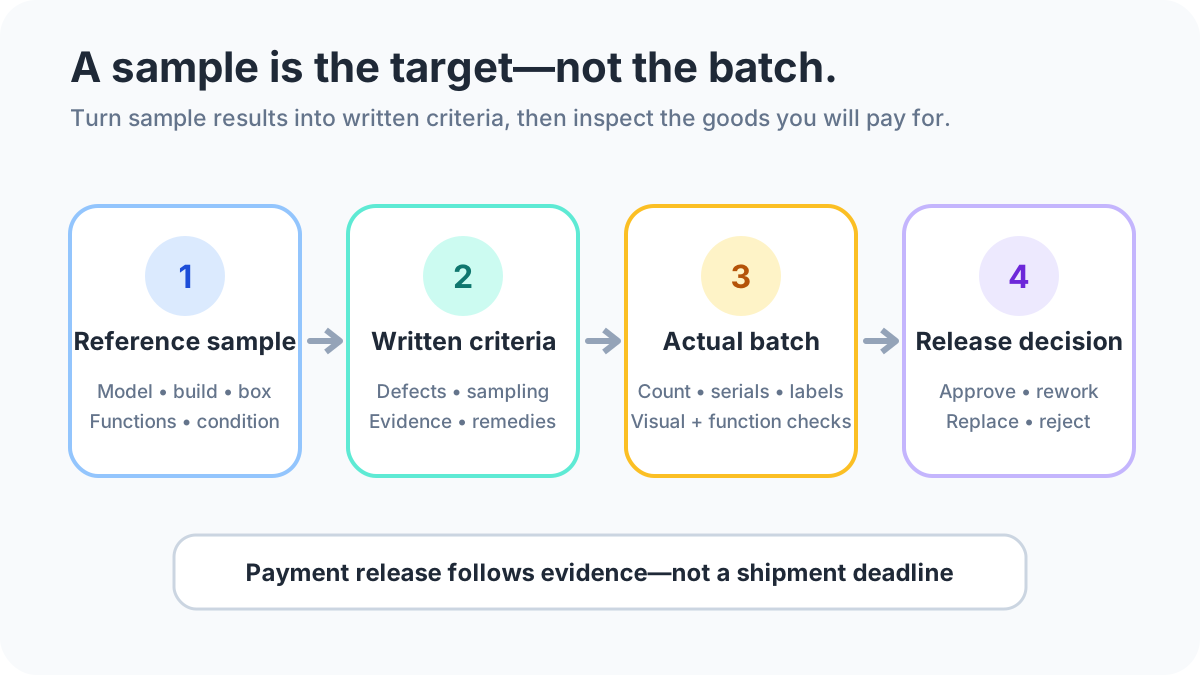
Open the full-size diagram of the sample, the criteria, and the batch.
6. Match the destination file to the same model
Do this before the deposit. A supplier who can ship a carton has not shown that you can place those phones on the destination market.
United States. Section 2.803 defines marketing to include sale or lease, offers, advertising, and importation, shipment, or distribution for the purpose of selling or leasing. The general rule requires a valid FCC equipment authorization that has not been limited under § 2.939(e), plus the identification and labeling that apply to the authorization path. The eCFR page states that the eCFR is not an official legal edition of the CFR. 4
Section 2.1204 says a radio frequency device can be imported only when at least one listed condition is met. The condition that matches a phone you will sell is a valid equipment authorization that has not been limited under § 2.939(e). The testing condition is 4,000 or fewer units for testing and evaluation, product development, or suitability for marketing, and those devices will not be offered for sale or marketed. Personal use is three or fewer devices, not for sale. A pre-sale path allows 12,000 or fewer units of the same FCC ID only after an accredited laboratory has finished compliance testing and a certification application is with a Telecommunication Certification Body. Those units need the temporary label that forbids delivery to end users, display, or operation before the grant, and the importer keeps recipient records for 60 months. The ultimate consignee has to be able to document which condition was used. 5
For an online marketplace that markets a radio frequency device subject to certification, and that has physical access to the device or takes title, compliance with the duty to display a valid FCC ID at the point of sale is not required until 1 March 2027. For a marketplace that markets such a device for a third-party seller and neither has physical access nor takes title, compliance with the related display duty is not required until 1 June 2027. Used devices are outside those two display duties. The authorization duty in section 2.803 is separate from those dates. 4
European Union. Directive 2014/53/EU defines radio equipment as an electrical or electronic product that intentionally emits or receives radio waves for radio communication or radiodetermination, including a product that does so once an accessory such as an antenna is fitted. A phone that intentionally emits and receives radio waves for cellular communication fits that definition. Article 12 says importers place only compliant radio equipment on the market. Before they do, the manufacturer has carried out the conformity assessment, the equipment can be operated in at least one Member State without infringing applicable requirements on the use of radio spectrum, the technical documentation exists, the equipment bears the CE marking and the documents Article 10 requires, and the manufacturer has met Article 10(6) and 10(7). The importer keeps a copy of the EU declaration of conformity for 10 years after the equipment is placed on the market and makes sure the technical documentation can be produced on request. Article 14 treats the importer as the manufacturer when the importer places the equipment on the market under the importer’s own name or trade mark, or modifies equipment already placed on the market in such a way that compliance with the Directive may be affected. 6
If a certificate does not name the model and the manufacturer on the carton, the file is still open.
7. Write the payment so it waits for a named record
The contract names the seller’s Chinese and English legal names, the SKU, the condition, the quantity, the reference unit, the acceptance criteria, who decides a pass, the Incoterms 2020 rule and the place, the currency, the beneficiary, and the document required before each transfer.
The ICC page for Incoterms 2020 says the rules define buyer and seller responsibilities and allocate cost, risk, and obligations. FCA was revised so the parties can agree that the buyer will instruct the carrier to issue an on-board bill of lading to the seller after loading. CIP requires cover compliant with Institute Cargo Clauses (A) or similar clauses. CIF, which the page reserves for maritime trade, keeps Institute Cargo Clauses (C) as the default, and the parties can agree a higher cover. Under DAP the seller does not unload. Under DPU the seller does. Put the 2020 rule and the place on the same line of the quote so those differences have a location. 9
For a first order, split the transfer into the record that opens the order, the record that shows the batch is available to inspect, and the record that releases the balance after inspection and the radio and battery files. The page does not print a deposit percentage. Leave that cell blank.
8. Classify the battery before you book the route
Mobile phones use lithium-ion batteries. The IATA guidance revised for the 2026 regulations, with page dates of 1 January 2026, says that document is guidance based on the 2025-2026 ICAO Technical Instructions and the 67th edition of the IATA Dangerous Goods Regulations, and that it is not itself a compliance text. It classifies lithium-ion batteries shipped alone as UN 3480. Lithium-ion batteries contained in equipment, and lithium-ion batteries packed with equipment, are UN 3481. Power banks and similar packs whose job is to charge another device are batteries, and they are not batteries contained in equipment. 8
Scroll horizontally to read the labels in this diagram.
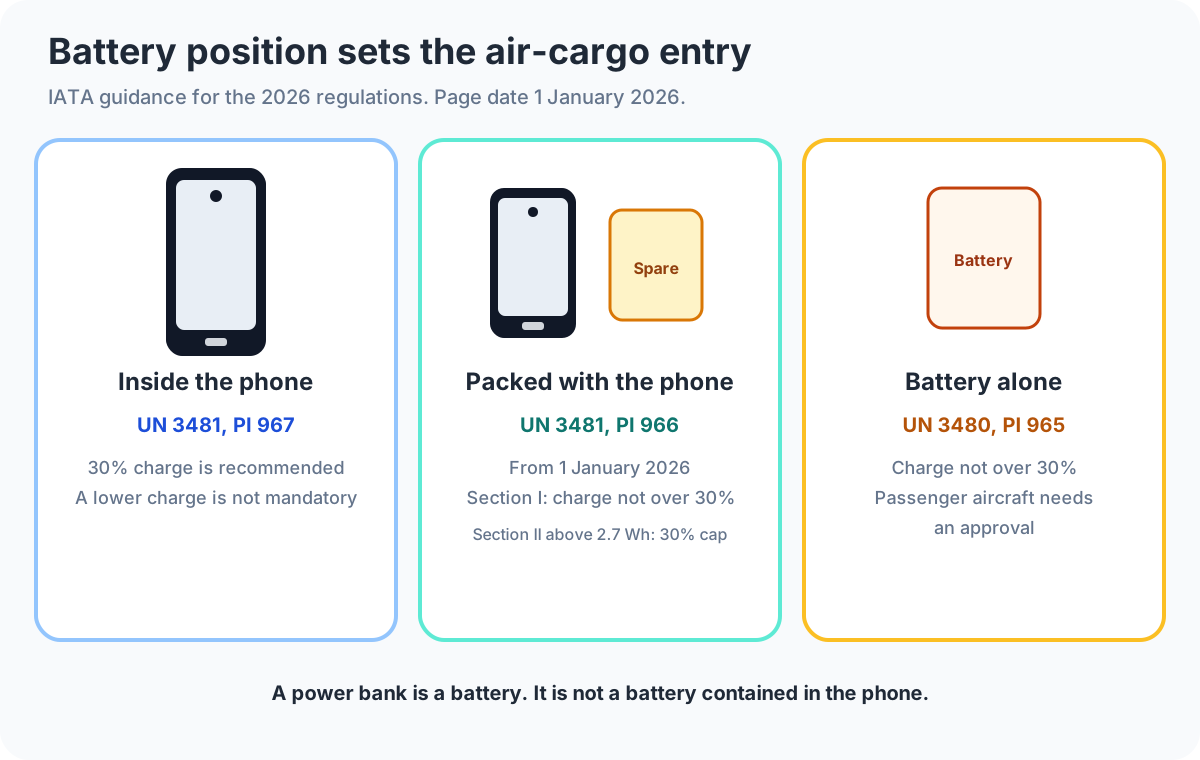
Open the full-size diagram of the three battery positions.
Scroll horizontally to view all table columns.
| Position | Entry in the IATA 2026 guidance | Charge rule printed there |
|---|---|---|
| Battery inside the phone | UN 3481, PI 967, Section I and Section II | Recommended: state of charge not exceeding 30% of rated capacity, or indicated battery capacity not exceeding 25%. A reduced state of charge is not mandatory |
| Battery packed with the phone | UN 3481, PI 966, from 1 January 2026 | Section I: state of charge not exceeding 30%. Section II: the same cap when the watt-hour rating exceeds 2.7 Wh, unless the State of Origin and the State of the Operator approve otherwise |
| Battery alone | UN 3480, PI 965 | State of charge not exceeding 30%, and passenger aircraft only with the approval in Special Provision A201 |
The watt-hour rating of a named phone is blank on every page saved for this article. Read it from the case mark or the test summary. Under 49 CFR 173.185, each lithium-ion battery must be marked with the watt-hour rating on the outside case beginning 10 May 2024. Each manufacturer and later distributor of lithium cells or batteries manufactured on or after 1 January 2008, other than button cells installed in equipment, must make a test summary available. When the summary is for a product that contains the cell or battery, the product model number can stand in for the cell model number. The summary also names the manufacturer, the laboratory, the report number and date, the mass, the watt-hour rating or lithium content, the tests and results, and the edition of the UN Manual of Tests and Criteria. The manufacturer keeps the underlying test record for as long as that design is offered for transport and for one year after. Cells and batteries must be of a type shown to meet part III, subsection 38.3 of that manual. 7
The smaller-cell exception stops at 20 Wh for a lithium-ion cell and 100 Wh for a lithium-ion battery. For air transport under that exception, the net mass of the cells and batteries in the completed package must not exceed 5 kg, and spare sets stop at two. The lithium battery mark is required except for button cells contained in equipment, or a consignment of two packages or fewer where each package holds not more than four lithium cells or two lithium batteries contained in equipment. A lot with more than two packages, or a package with more than two batteries inside equipment, is outside that exception.
Worked example. Net lithium-ion mass in one package = battery mass printed on the test summary × battery count in that package. The 5 kg ceiling is the figure in 49 CFR 173.185(c)(4)(i). Arithmetic, with inputs the saved pages do not print: battery mass is blank, battery count is blank, and the product is blank. Compare the product with 5 kg only after the test summary prints the mass.
9. Compute the cost per sellable unit, and leave the missing inputs blank
Sellable-unit cost = (invoice + inspection + freight + insurance + duty the entry assesses + brokerage + cost of units you cannot sell) / sellable units.
The importer of record, using reasonable care, files the declared value, the classification, and the rate of duty. That duty is in 19 U.S.C. 1484, 2023 edition. 10
Chapter 85 of the Harmonized Tariff Schedule, Revision 21 (2026), note 5, defines smartphones for heading 8517 as telephones for cellular networks, equipped with a mobile operating system designed to perform the functions of an automatic data processing machine, such as downloading and running multiple applications at the same time, including third-party applications, whether or not the phone also has a camera or a navigation system. The statistical line 8517.13.00 00, Smartphones, prints unit No., Column 1 General Free, and Column 2 35%. The USITC search response for 8517.13.00.00 repeats general Free, special as an empty string, other 35%, and additionalDuties null. The row does not print a separate rate for used or refurbished phones. 11 12
Scroll horizontally to view all table columns.
| Cost input | Figure from the saved pages | Your document |
|---|---|---|
| Unit price | blank | ___ |
| Minimum order | blank | ___ |
| Lead time | blank | ___ |
| Entered value | blank | ___ |
| Column 1 General rate, if classified in 8517.13.00.00 | Free | ___ |
| Column 1 Special | blank | ___ |
| Column 2 rate | 35% | ___ |
| Additional duties | null | ___ |
| Freight, insurance, brokerage | blank | ___ |
| Battery mass and watt-hours | blank | ___ |
| Rejected or unsellable units | blank | ___ |
| Sellable units | blank | ___ |
Worked example. Column 1 General duty = entered value × the printed general rate. Arithmetic: the printed general rate is Free, so that column’s duty is zero when the phones are classified on 8517.13.00.00. The dollar amount stays blank because no saved page prints an entered value. Column 2 amount = entered value × 35% only when Column 2 is the rate that applies, and that dollar amount is blank for the same reason. additionalDuties is null, so this page adds no Chapter 99 figure.
When this file is the wrong file
The FCC sections apply to radio frequency devices imported into or marketed in the United States. The radio-equipment directive applies when the goods are radio equipment placed on the Union market. A destination outside those two files needs the text that destination prints. The HTS line applies when the goods meet note 5. A phone that is not a smartphone under that note needs its own heading, and this page does not print that heading.
Pause the order on these mismatches
- The supplier will not give the Chinese legal name that you can set beside the publicity record.
- The contract, the invoice, and the bank beneficiary name different parties, and the contract does not explain the link.
- The model, the market version, or the software build is still open on the day you are asked to pay.
- The CE marking or the FCC grant does not name the model and the manufacturer on the carton.
- The import condition you are offered states that the devices will not be offered for sale, and your order is for resale.
- The test-summary model number and the carton model number differ.
- A power bank in the carton is booked as a battery contained in the phone.
- The forwarder cannot say whether the booking is UN 3480 or UN 3481.
What was saved
The sentences above use pages saved on 18 October 2026 from the State Administration for Market Regulation, Google, Android, the eCFR, EUR-Lex, IATA, the International Chamber of Commerce, the U.S. Code, and the U.S. International Trade Commission. The eCFR pages state that they are not an official legal edition of the CFR. The IATA file states that it is guidance. Price, minimum order, lead time, entered value, and battery mass are blank because those pages do not print them. Copy the blank rows, attach the document that fills each one, and hold the next payment until that document is the one you named.
Frequently Asked Questions
Does Free on HTS 8517.13.00.00 mean a China phone shipment has no other duty?
No. Harmonized Tariff Schedule Revision 21 (2026) prints Column 1 General as Free and Column 2 as 35% for 8517.13.00.00, smartphones. The USITC search response saved on 18 October 2026 sets additionalDuties to null, so any extra duty line stays blank until an official page prints it.
Does the National Enterprise Credit Information Publicity System prove the supplier holds this phone batch?
No. The regulation saved from the State Administration for Market Regulation lists registration and filing information, chattel mortgages, equity pledges, administrative penalties, and other information the law requires. Stock, a brand authorization, and a serial-numbered batch are outside that list.
Can phones imported under the 4,000-unit FCC test condition be sold?
No. 47 CFR 2.1204(a)(3) limits that import to 4,000 or fewer units for testing and evaluation to determine compliance, product development, or suitability for marketing, and it states that the devices will not be offered for sale or marketed.
Sources & methodology12 sources
Evidence used for this article. Links open the original source in a new tab.
- Interim Regulation on Enterprise Information Publicity, as revised in 2024 — State Administration for Market Regulation
- Check and fix Play Protect certification status — Google Play Help
- Play Protect certified Android devices — Android
- 47 CFR 2.803 Marketing of radio frequency devices — eCFR
- 47 CFR 2.1204 Import conditions — eCFR
- Directive 2014/53/EU on radio equipment — EUR-Lex
- 49 CFR 173.185 Lithium cells and batteries — eCFR
- Battery Guidance Document, revised for the 2026 regulations — International Air Transport Association
- Incoterms 2020 — International Chamber of Commerce
- 19 U.S.C. 1484 Entry of merchandise (2023 edition) — U.S. Government Publishing Office
- Harmonized Tariff Schedule Chapter 85, Revision 21 (2026) — U.S. International Trade Commission
- HTS search result for 8517.13.00 — U.S. International Trade Commission
TasteOfAndroid is responsible for this page. The byline, method and commercial relationships are on the editorial policy and the author page.